

2026-07-14 NASA
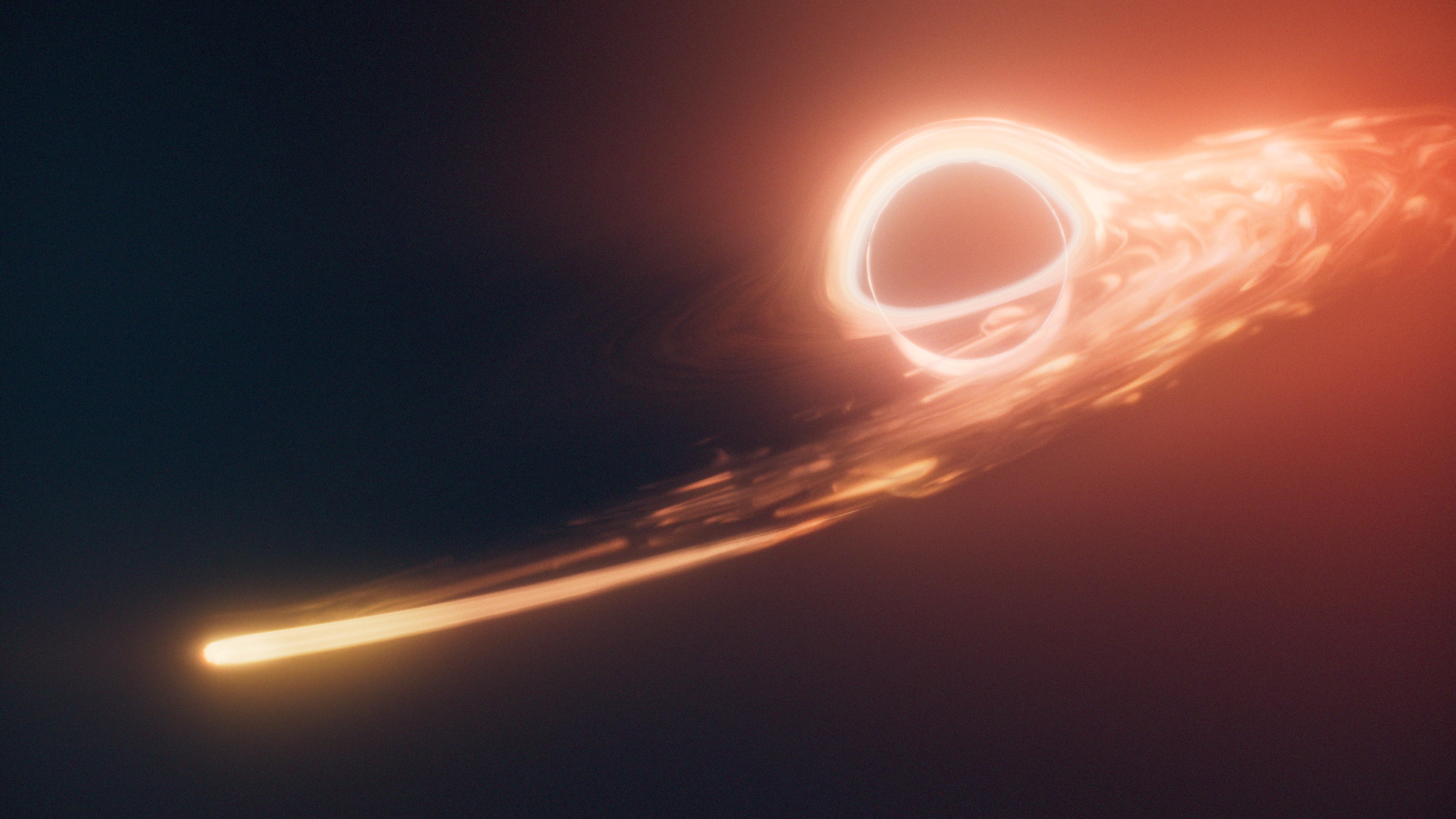
This artist’s concept portrays a Sun-like star being shredded by a supermassive black hole — a phenomenon known as a tidal disruption event. NASA, Ralf Crawford (STScI)
<関連情報>
- https://www.nasa.gov/missions/roman-space-telescope/nasas-roman-telescope-will-spot-distant-black-holes-that-shred-stars/
- https://iopscience.iop.org/article/10.3847/1538-4357/ae7a49
宇宙時間における潮汐破壊事象の発生率:LSST、Roman、JWSTによる予測と、それらが超大質量ブラックホールの質量関数に及ぼす制約 Tidal Disruption Event Rates across Cosmic Time: Forecasts for LSST, Roman, and JWST and Their Constraints on the Supermassive Black Hole Mass Function
Mitchell Karmen, Suvi Gezari, Colin Norman, and Muryel Guolo
The Astrophysical Journal Published: 2026 July 14
DOI:10.3847/1538-4357/ae7a49
Abstract
Measuring the mass distribution of supermassive black holes (SMBHs) over cosmic time remains particularly challenging for the low-mass (M• ≲ 108 M⊙) population at z > 1. This population is also the most sensitive to SMBH seeding and early growth models. In this work, we construct a semiempirical model for the redshift evolution of the tidal disruption event (TDE) rate under multiple SMBH mass function prescriptions, and show that the observed redshift-dependent rate of TDEs is very sensitive to the SMBH mass function and its evolution with redshift. We further incorporate galaxy-scale processes that evolve with redshift—namely, increasing galaxy nuclear stellar densities, enhanced galaxy–galaxy merger rates, dust obscuration, and a possible top-heavy initial mass function at early cosmic times—and quantify their combined impact on the TDE rate. We find that including these effects generally results in a volumetric TDE rate that increases with redshift until a maximum near cosmic noon, before declining at higher redshift, where SMBHs that can disrupt stars become increasingly scarce. We forecast TDE rates in the Rubin Legacy Survey of Space and Time (LSST) and the Roman High Latitude Time Domain Survey, alongside expectations for serendipitous TDE rates in the JWST COSMOS-Web survey. Finally, we provide a methodology for using a flux-limited survey of TDEs in LSST to directly constrain the redshift evolution of the SMBH mass function.

