2026-07-13 東北大学
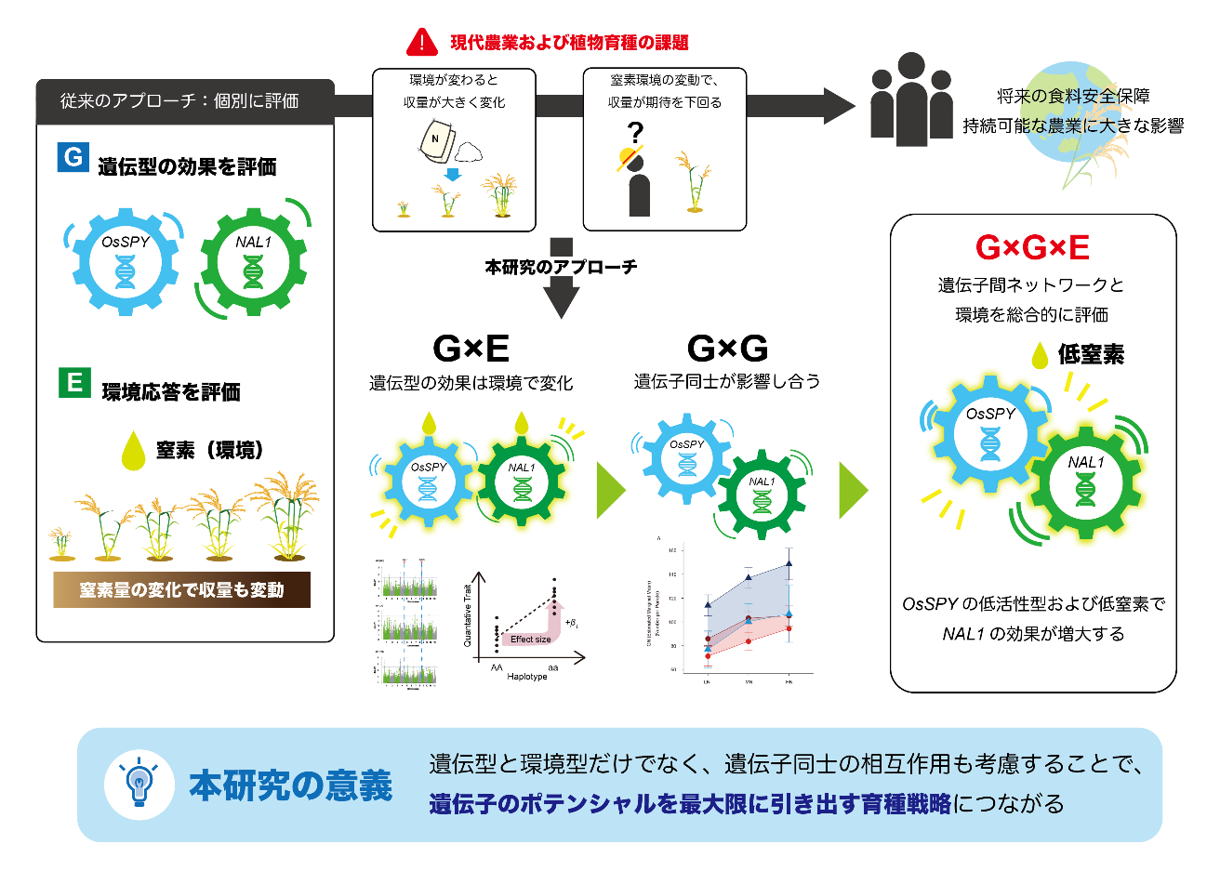
図1. 研究の概要
<関連情報>
- https://www.tohoku.ac.jp/japanese/2026/07/press20260713-02-rice.html
- https://www.sciencedirect.com/science/article/pii/S1672630826000843
窒素利用可能性によって調節されるNAL1-OsSPY相互作用がイネの穂の構造を制御する Interaction of NAL1-OsSPY Modulated by Nitrogen Availability Controls Panicle Architecture in Rice
Keiichi Honda, Mao Suganami, Hideki Yoshida, Takashi Akagi, Makoto Matsuoka, Soichi Kojima
Rice Science Available online: 15 June 2026
DOI:https://doi.org/10.1016/j.rsci.2026.06.001
Abstract
In genomic breeding, approaches centered on genome-wide association study (GWAS) have elucidated many loci underlying target traits. However, the conventional approaches focusing on the effects of independent genetic factors do not properly reflect phenotypic variation arising from interactions between genetic background and environmental conditions. In this study, regarding yield-related traits in rice, we focused on two strong GWAS peaks for grain number (GN), corresponding to the known genes NARROW LEAF1 (NAL1) and Oryza sativa SPINDLY (OsSPY). NAL1 negatively regulated GN in a nitrogen-dependent manner, whereas OsSPY positively regulated GN irrespective of nitrogen conditions. Examination of haplotype combinations across nitrogen conditions using imbalance-aware statistical estimation allowed modeling of the interaction effects of NAL1 and OsSPY on GN. Specifically, under low nitrogen conditions, the effect of NAL1 was markedly enhanced, being approximately two-fold greater in the background of the low-activity OsSPY haplotype than in that of the high-activity haplotype. These findings provide a framework integrating haplotype combinations with environmental context to better explain phenotypic variation, thereby highlighting genotype-by-genotype-by-environment (G × G × E) interactions underlying rice performance under variable environmental conditions. This perspective complements and extends conventional genetic approaches, enabling a deeper understanding of complex trait architecture in natura.