2026-07-08 中国科学院(CAS)
中国科学院西双版納熱帯植物園(XTBG)の研究チームは、赤外線カメラを搭載したドローンが野生アジアゾウの高頻度・リアルタイム追跡に有効であり、人身被害の防止や保全管理に役立つことを実証した。2021年に17頭のアジアゾウが植物園へ侵入した際、20日間にわたり毎時観測を実施した結果、全体の発見率は62.7%、夜間、とくに深夜には95%に達した。赤外線カメラは暗所や森林の樹冠下でも高い探知性能を示した。また、ゾウは人間活動が少ない早朝と夜間に活発に移動し、人との遭遇を避ける行動をとることが明らかとなった。さらに、生息地選択解析から、水辺や緩斜面を好む一方、樹冠構造や植生密度の影響は小さいことが判明した。試験期間中はドローン情報を活用して管理体制を柔軟に調整し、人身事故は発生しなかった。研究チームは、夜間飛行や河川沿いの重点監視を推奨するとともに、ドローンは既存の地上監視を補完する統合的な早期警戒システムとして活用すべきであると提言している。
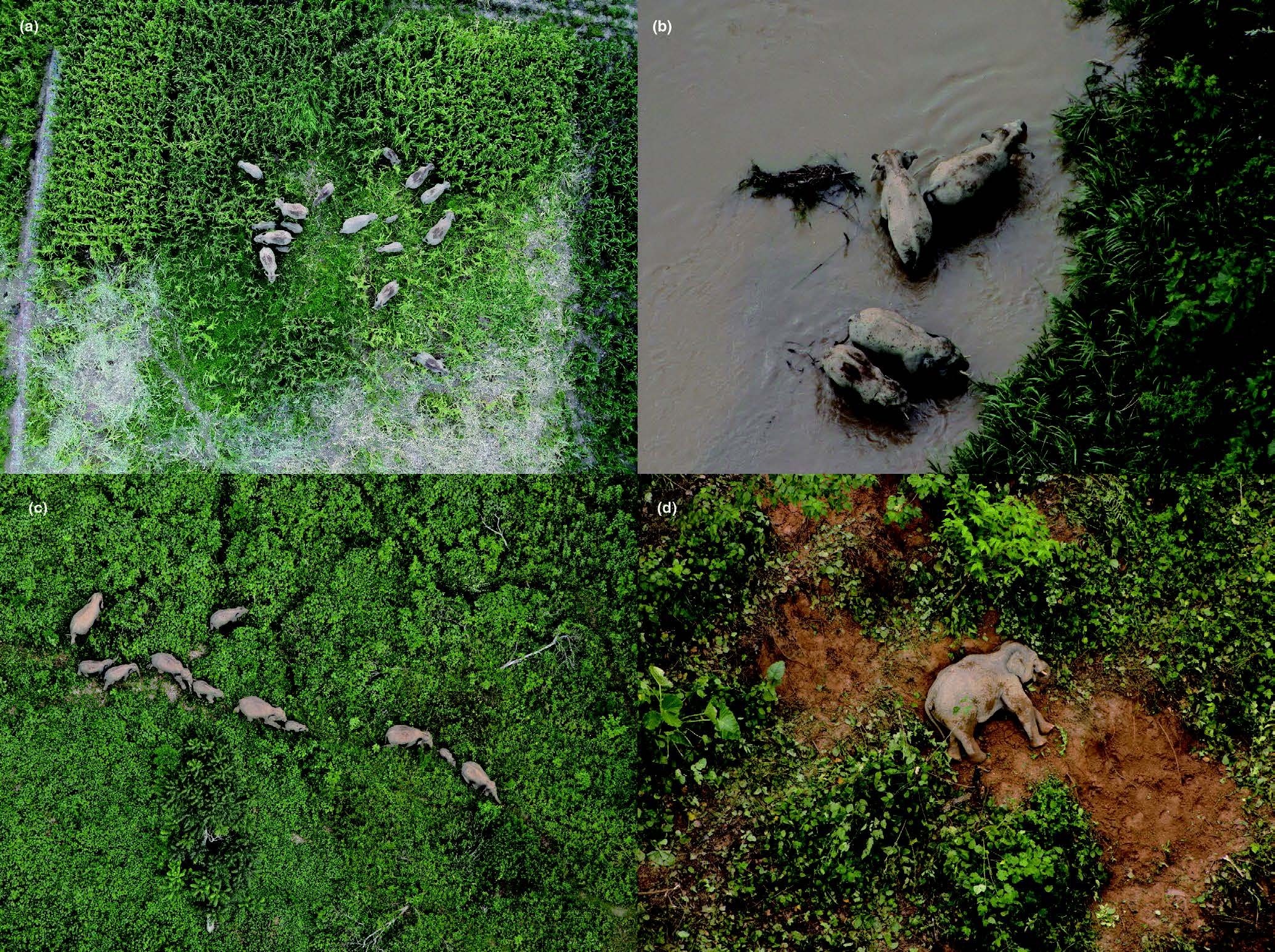
Examples of elephant behaviours: (a) feeding; (b) drinking/bathing; (c) moving; (d) resting (Image by XTBG)
<関連情報>
- https://english.cas.cn/newsroom/research-news/202607/t20260710_1176948.shtml
- https://besjournals.onlinelibrary.wiley.com/doi/10.1111/1365-2664.70457
紛争緩和と生態学的研究のための、野生アジアゾウの効果的な精密ドローン監視 Effective fine-scale drone monitoring of wild Asian elephants for conflict mitigation and ecological research
Yun Deng, Shendong Yuan, Hui Chen, Bo Wang, Junsong Li, Kang Luo, Ahimsa Campos-Arceiz
Journal of Applied Ecology Published: 25 June 2026
DOI:https://doi.org/10.1111/1365-2664.70457
Abstract
- Obtaining high-resolution spatiotemporal data on animal behaviour is critical for both ecological research and conflict mitigation, yet it remains difficult for large species in dense habitats.
- In May–June 2021, a herd of 17 wild Asian elephants (Elephas maximus) entered and remained at the Xishuangbanna Tropical Botanical Garden, a popular tourist destination and research facility in south-western Yunnan, China. We took advantage of this rare and unforeseen incursion to test the effectiveness of small unmanned aerial vehicles (or drones) equipped with infrared cameras for monitoring wildlife at high spatiotemporal resolution in tropical forests near human activity. To monitor the elephants during this sensitive period, we aimed to locate the elephants and record their behaviours on an hourly basis over 20 days.
- Our drone-based monitoring achieved a 62.7% success rate in locating elephants, with detection rates peaking at night (~95% at midnight). Generalized linear models showed that detection declined with rising temperature, rainfall and solar radiation, but improved with higher humidity and visibility. Elephants spent 45.9% of their time feeding, 27.2% resting, 19.9% moving and 7% drinking. Step-selection functions revealed a strong preference for habitats near water sources and on gentle slopes, while canopy structure had negligible effects.
- Synthesis and applications: Our results demonstrate that drone-based monitoring can feasibly track large mammals in complex field environments while providing quantitative benchmarks for elephant behaviour under real-world conditions. In turn, these findings underscore the potential of drone technology to enhance wildlife monitoring and support effective human–elephant conflict management. Specifically, we recommend prioritizing night flights when detection probability peaks, taking advantage of short clear-weather windows, avoiding periods of heavy rain and intense solar radiation, and concentrating search efforts along riparian corridors and gentle slopes where elephants are most likely to occur.