2026-07-10 東京科学大学
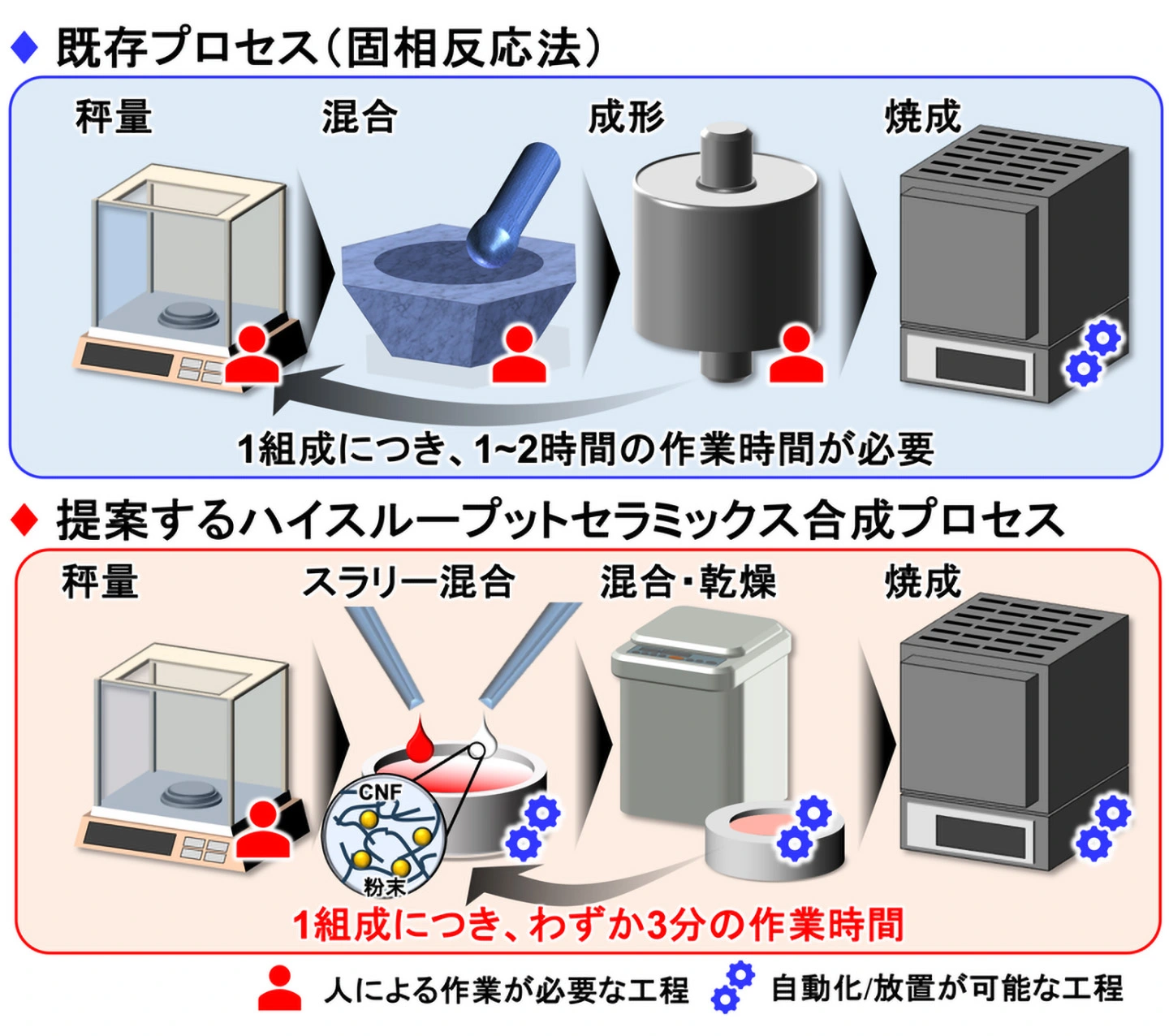
図1. 既存のセラミックス合成プロセスと提案プロセスの模式図
<関連情報>
- https://www.isct.ac.jp/ja/news/acuhsa6f79w4#top
- https://pubs.rsc.org/tc/article-abstract/doi/10.1039/d6tc01175f/1268756/High-throughput-ceramics-processing-method-using
セルロースナノファイバー分散液を用いた高スループットセラミックス加工法による迅速な材料探索
High-throughput ceramics processing method using cellulose nanofiber dispersions for rapid materials exploration
Sou Yasuhara;Yosuke Sugita;Masaki Tozuka;Takuya Hoshina
Journal of Materials Chemistry C Published:26 June 2026
DOI:https://doi.org/10.1039/d6tc01175f
A high-throughput synthesis is one of the most promising approaches for exploring chemical compositions that optimize material properties. A new high-throughput ceramics processing method is established by using a cellulose nanofiber (CNF) dispersed water as a forming medium. Because the CNF-dispersed water provides binding ability, good dispersibility for inorganic powders, and thixotropy, the dried mixtures form mechanically robust green pellets that can be directly sintered, eliminating the weighing, mixing, and pelletization steps of conventional solid-state processing. In this study, to elucidate the effectiveness of the proposed high-throughput process, several perovskite-type dielectric ceramics were prepared and evaluated. The prepared ceramics of BaTiO3 and BaTiO3–SrTiO3 solid solution system successfully reproduced reported properties. The results for the BaTiO3–SrTiO3–CaTiO3 ternary system showed compositional dependencies in lattice distortion (c/a), dielectric constant (εr), and phase transition temperature (TC). Finally, a chemical composition to improve the temperature stability of εr was explored using the Ba0.55Sr0.15Ca0.30(Ti1–0.01xZr0.01x)O3 system. The chemical composition Ba0.55Sr0.15Ca0.30(Ti0.91Zr0.09)O3 exhibited excellent temperature stability in the range of 30–125 °C. These results suggest the importance of the proposed high-throughput ceramics processing method as a tool to accelerate materials exploration.