2026-06-29 ローレンス・バークレー国立研究所(LBNL)
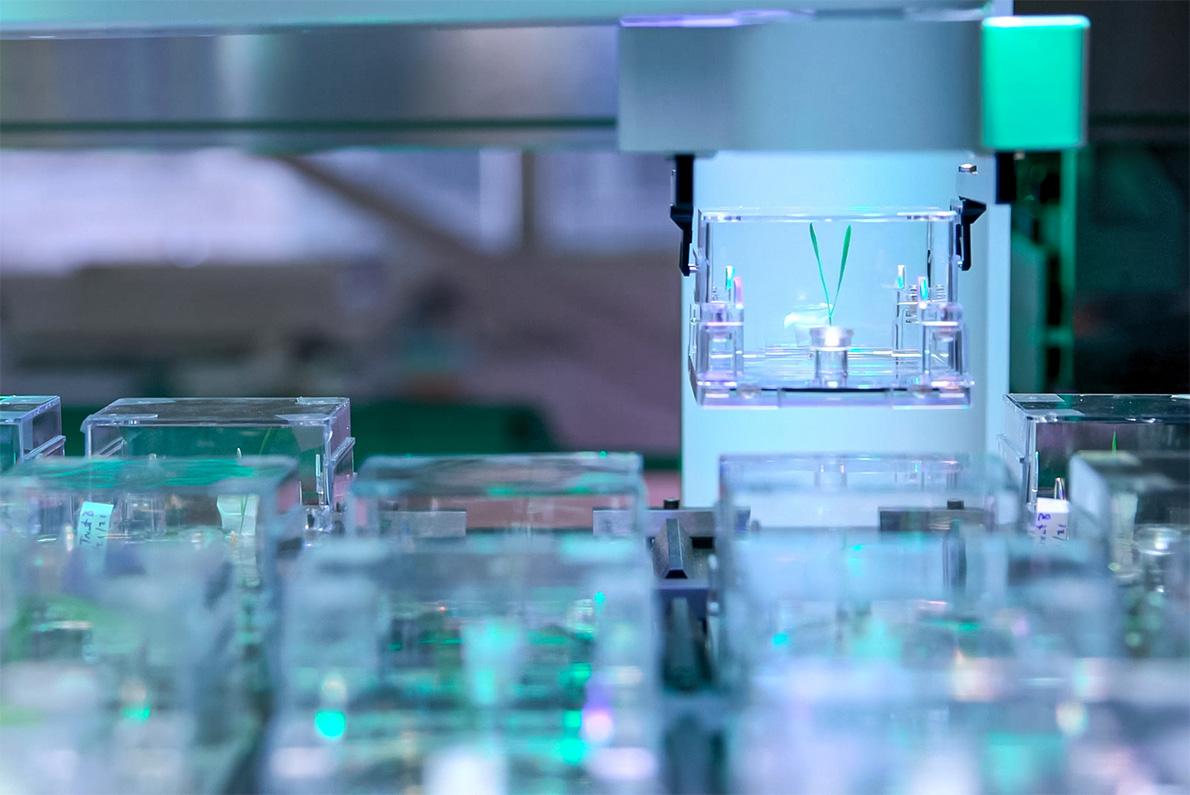
Inside the EcoBOT cabinet, a robotic arm lifts a sterile EcoFAB growth chamber containing a small plant shoot. This highly controlled, automated environment allows the system to continuously monitor plant responses to stressors without the risk of human error or outside microbial contamination. (Credit: Marilyn Sargent/Berkeley Lab)
<関連情報>
- https://newscenter.lbl.gov/2026/06/29/meet-ecobot-the-autonomous-lab-standardizing-plant-microbe-research/
- https://science.osti.gov/-/media/ber/pdf/workshop-reports/2026/Microbiome-Research-Workshop-Report_Final-Web.pdf
- https://www.frontiersin.org/journals/plant-science/articles/10.3389/fpls.2025.1633557/full
- https://tiisys.com/blog/2026/03/31/post-189388/
EcoBOT:AI/MLを活用したモデル植物の自動表現型解析機能 EcoBOT: an AI/ML enabled automated phenotyping capability for model plants
Peter F. Andeer,Petrus H. Zwart,Daniela Ushizima,Marcus M. Noack,Lloyd T. Cornmesser,Thomas M. Vess,Zineb Sordo,Stephen Tan,+ 7 more,Trent R. Northen
Frontiers in Plant Science Published:02 December 2025
DOI:https://doi.org/10.3389/fpls.2025.1633557
Abstract
Introduction:
Advances in automation and AI/ML offer new opportunities for plant science, including design, modeling, and analysis. This study aimed to develop an automated platform for researching small model plants under axenic conditions and integrate it with AI/ML tools.
Methods:
The EcoBOT platform was developed, which consists of sterile containers (EcoFABs) for growing plants and imaging for monitoring plant growth and health. Brachypodium distachyon was grown on the EcoBOT, and its response to nutrient limitation and copper stress was evaluated.
Results:
The results showed that Brachypodium distachyon grown in the EcoBOT maintained sterility and responded to nutrient limitation and copper stress. Analysis of over 6,500 root and shoot images revealed varying sensitivity and response rates to copper. Bayesian Optimization was used to improve model accuracies relating copper concentrations to plant biomass via sequential experiments, resulting in a >30% improvement.
Discussion:
The findings of this study demonstrate the potential of the EcoBOT platform for researching plant responses to environmental factors. Future experiments could focus on relating other chemical stresses and microbial interactions to create generalized models of plant responses.
人工生態系における植物のハイパースペクトルセグメンテーション Hyperspectral segmentation of plants in fabricated ecosystems
Petrus H. Zwart,Peter Andeer,Trent R. Northen
Frontiers in High Performance Computing Published:17 February 2025
DOI:https://doi.org/10.3389/fhpcp.2025.1547340
Abstract
Hyperspectral imaging provides a powerful tool for analyzing above-ground plant characteristics in fabricated ecosystems, offering rich spectral information across diverse wavelengths. This study presents an efficient workflow for hyperspectral data segmentation and subsequent data analytics, minimizing the need for user annotation through the use of ensembles of sparse mixed scale convolution neural networks. The segmentation process leverages the diversity of ensembles to achieve high accuracy with minimal labeled data, reducing labor-intensive annotation efforts. To further enhance robustness, we incorporate image alignment techniques to address spatial variability in the dataset. Downstream analysis focuses on using the segmented data for processing spectral data, enabling monitoring of plant health. This approach provides a scalable solution for spectral segmentation, and facilitates actionable insights into plant conditions in complex, controlled environments. Our results demonstrate the utility of combining advanced machine learning techniques with hyperspectral analytics for high-throughput plant monitoring.