2026-07-13 東北大学
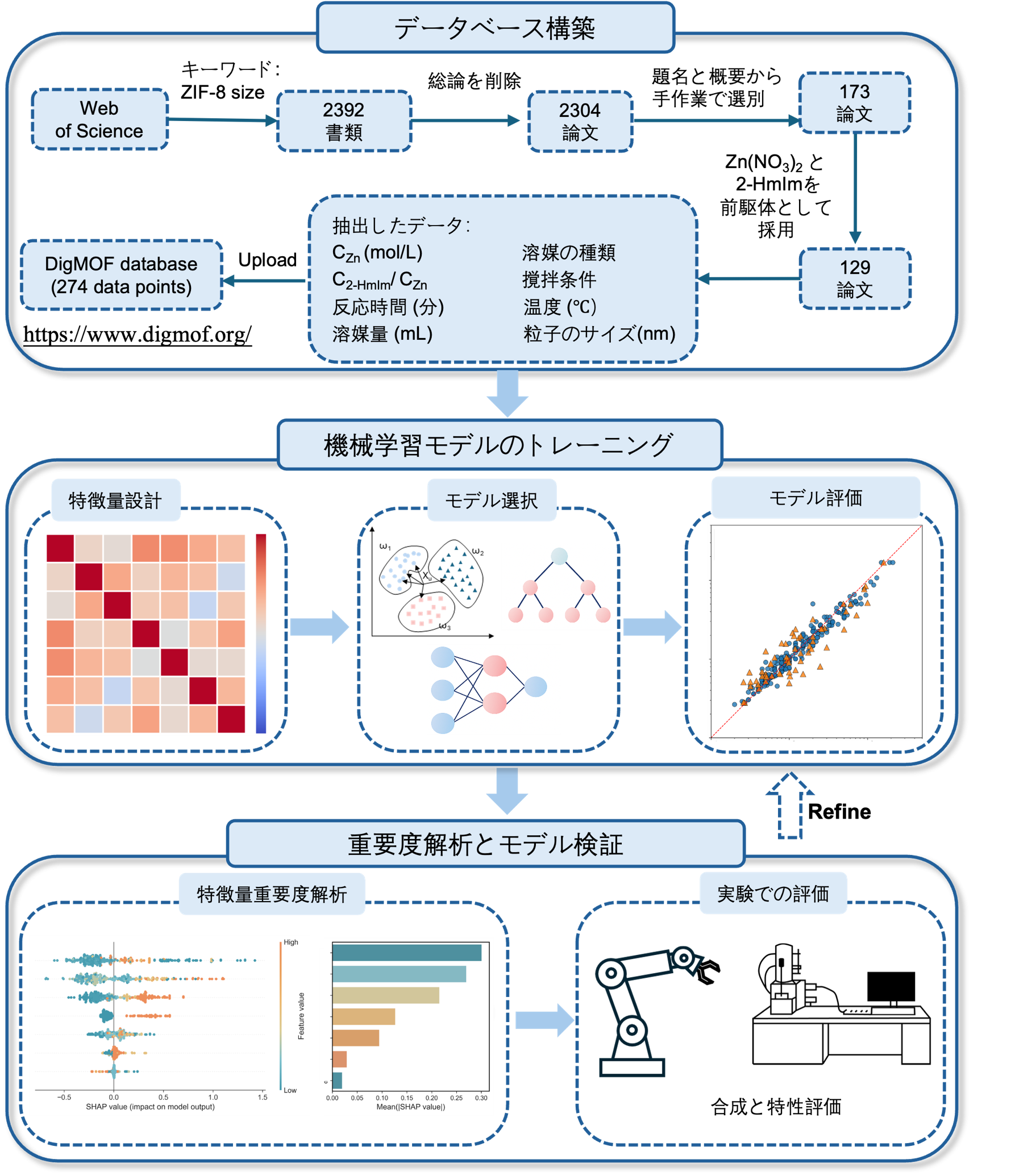
図1. MOFの粒径を制御するための、AI・データ解析を活用した材料作製の流れ。
<関連情報>
- https://www.tohoku.ac.jp/japanese/2026/07/press20260713-01-mof.html
- https://pubs.rsc.org/sc/article/doi/10.1039/d6sc03212e/1267532/Materials-process-informatics-assisted-precise
材料プロセス情報学を活用した金属有機構造体の精密な粒子サイズ制御
Materials process informatics-assisted precise particle size control of metal–organic frameworks
Yuan Wang;Heng Liu;Yusuke Hashimoto;Kazuyuki Iwase;Hao Li;Takaaki Tomai
Chemical Science Published:20 June 2026
DOI:https://doi.org/10.1039/d6sc03212e
Precise control over the particle size of metal–organic frameworks (MOFs) is pivotal for optimizing their performance in catalysis, separation, and drug delivery. However, conventional synthetic strategies largely depend on empirical trial-and-error, which lacks predictive power and fails to decode the complex interplay between nucleation and growth kinetics. Herein, we report a materials process informatics framework for the predictive control of MOF particle size, using zeolitic imidazolate framework-8 (ZIF-8) as a representative model system. A comprehensive database was constructed through systematic curation from the literature, with seven process descriptors employed as input features. Multiple machine-learning algorithms were benchmarked, among which the Categorical Boosting (CB) model achieved the best predictive performance after hyperparameter optimization, with a coefficient of determination (R2) of 0.90 on the test set. Furthermore, SHapley Additive exPlanations (SHAP) analysis identified the precursor concentration ratio and reaction time as the most influential parameters governing particle size. Experimental validation using an automated synthesis platform showed excellent agreement between predicted and measured particle sizes, confirming the model’s robustness and predictive reliability. Overall, the proposed framework enables intelligent synthesis optimization and targeted experimental design, thereby providing a practical route toward controllable MOF synthesis. This work demonstrates how materials process informatics can shift MOF particle-size engineering from empirical optimization toward data-driven design, offering a broadly applicable strategy for advanced materials synthesis.