
2026-06-22 中国科学院(CAS)
<関連情報>
- https://english.cas.cn/newsroom/cas-in-media/202606/t20260622_1174374.shtml
- https://www.vertpala.ac.cn/CN/10.19615/j.cnki.2096-9899.260616
中国北部の前期白亜紀から発見された新たな羽毛恐竜は、初期ペンナラプトル類の進化の複雑さを浮き彫りにし、関連するいくつかの概念的および方法論的問題について考察する A new feathered dinosaur from Early Cretaceous of northern China highlighting the complexity of early pennaraptoran evolution and comments on several relevant conceptual and methodological issues
XU Xing
Vertebrata PalAsiatica
DOI:https://doi.org/10.19615/j.cnki.2096-9899.260616
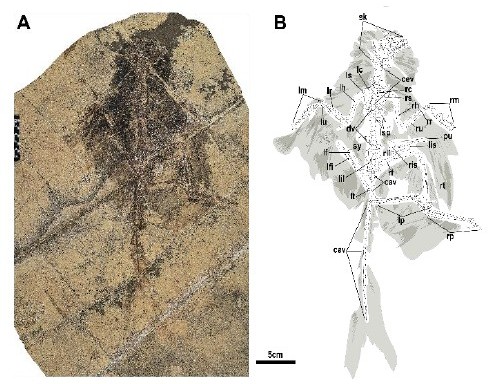
Fig. 1 Photograph (A) and line drawing (B) of Changzhousaurus sinensis holotype (LDNHMF 2026A)
Abstract
Recent discoveries of early-diverging pennaraptoran fossils have shed light on the origin of birds and, in particular, the evolution of defining avian features such as pennaceous feathers and flight capability. Here I report a new pennaraptoran dinosaur based on a fossil recovered from the Lower Cretaceous Jiufotang Formation of western Liaoning, China. Despite exhibiting a combination of derived features observed across distinct pennaraptoran lineages, this new taxon is likely an early-diverging deinonychosaurian. Most notably, it possesses exceptional plumage characteristics: it represents the first known early-diverging pennaraptoran to bear both large pedal feathers and highly elongated rectrices; these elongated rectrices are substantially more abundant than those of other early-diverging pennaraptorans, bearing a superficial resemblance to the tail plumes of peacocks; and its wing feathers form the proportionally largest feathered wings among non-avialan pennaraptorans—even with relatively short bony forelimbs—indicating a decoupling of forelimb skeletal length and feathered wing surface area. This discovery underscores the complexity of early pennaraptoran evolution and raises several conceptual and methodological issues in pennaraptoran research. These issues include how to recover a robust pennaraptoran phylogeny, how to infer the aerial behavior and habitat ecology of early-diverging pennaraptorans, and how to define feathers and birds. I briefly address these issues in this paper.

