2026-06-11 東北大学
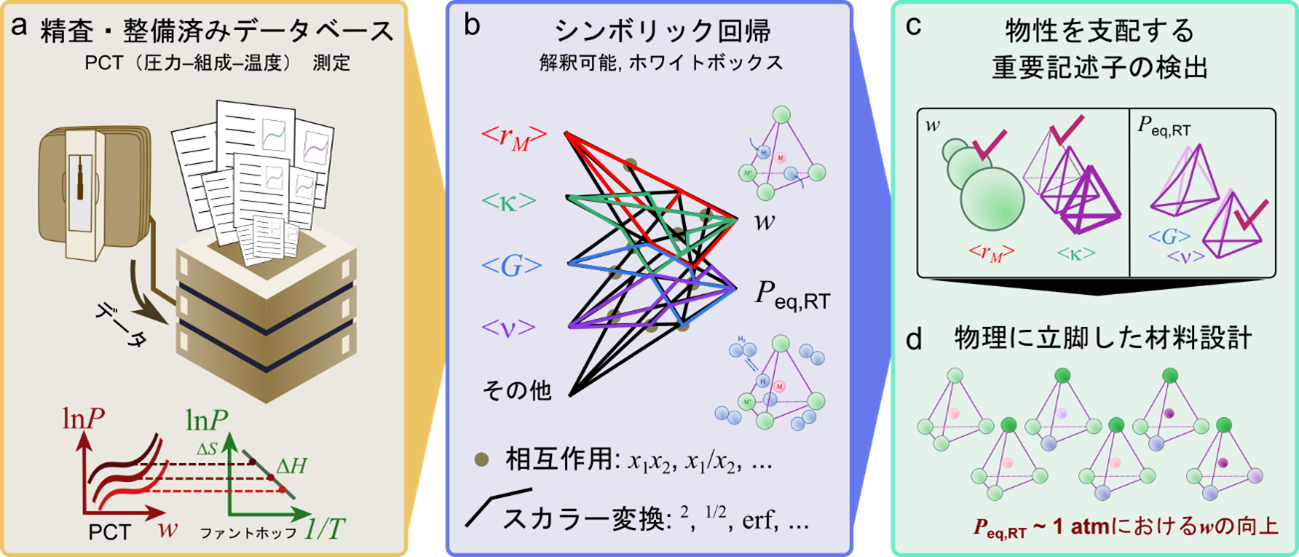
図1. 本研究の流れ。文献データベース DigHyd からPCT測定データを整理し、シンボリック回帰手法GoodRegressorにより重要な記述子を抽出、材料設計へつなげます。
<関連情報>
- https://www.tohoku.ac.jp/japanese/2026/06/press20260611-02-ai.html
- https://pubs.rsc.org/en/content/articlelanding/2026/sc/d6sc03089k
格子間水素化物における水素貯蔵容量と平衡圧力に関する統一的な記述子フレームワーク A unified descriptor framework for hydrogen storage capacity and equilibrium pressure in interstitial hydrides
Seong-Hoon Jang,Di Zhang,Xue Jia,Hung Ba Tran,Linda Zhang,Ryuhei Sato,Yusuke Hashimoto,Yusuke Ohashi,oyoto Sato,Kiyoe Konno,Shin-ichi Orimo and Hao Li
Chemical Science Published:25 May 2026
DOI:https://doi.org/10.1039/D6SC03089K
Abstract
Hydrogen is a promising energy carrier, yet its practical deployment is limited by the lack of storage materials that simultaneously achieve high storage capacity (w) and practical equilibrium pressure at room temperature (Peq,RT). Interstitial metal hydrides offer fast kinetics and favorable thermodynamics (high Peq,RT) but suffer from intrinsically low w. Here, we establish a physically interpretable, data-driven framework to uncover descriptor–property relationships in interstitial hydrides using a curated database of pressure-composition-temperature measurements (Digital Hydrogen Platform, DigHyd) and white-box symbolic regression. Strikingly, the analysis reveals a clear separation of governing mechanisms, in which w is governed by geometric and lattice conditions, captured by the average atomic radius (〈rM〉) and average thermal conductivity (〈κ〉), with an optimal regime of 〈rM〉 ∼ 1.47 Å and relatively low 〈κ〉. In contrast, Peq,RT is governed by elastic properties, captured by the average shear modulus (〈G〉) and average Poisson’s ratio (〈ν〉), reflecting the role of lattice rigidity and mechanical compliance. These relationships are translated into compositional optimization pathways that follow the descriptor trends above, enabling the design of candidate materials with enhanced w under practical equilibrium conditions (Peq,RT ∼ 0.1 MPa). This work establishes a general, interpretable strategy for physics-informed design of energy materials systems.