2026-06-30 東京科学大学
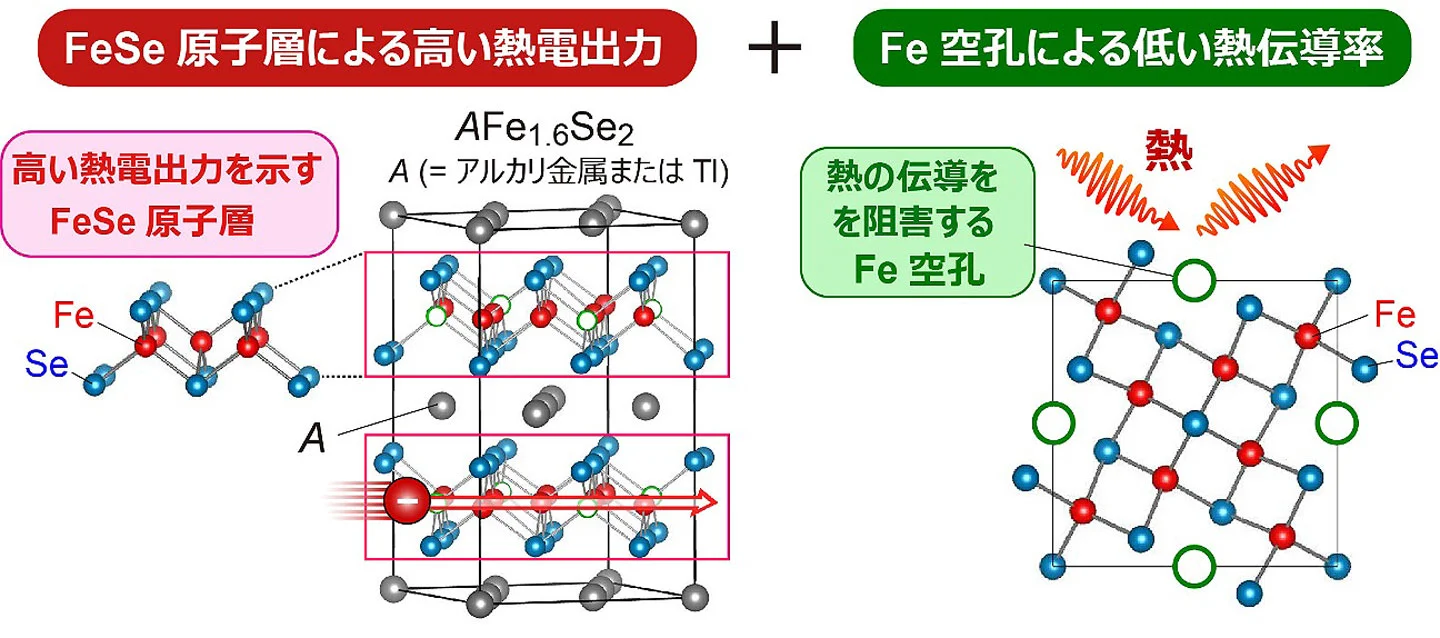
図1. 本研究で提案した熱電材料設計の概念図。FeSe原子層による高い熱電出力(左)とFe空孔による低い熱伝導率(右)の両方を同時に実現する。
<関連情報>
- https://www.isct.ac.jp/ja/news/f690ywrnzoed#top
- https://pubs.rsc.org/en/content/articlelanding/2026/ta/d6ta02075e
FeSe原子層を内包したTlFe1.6Se2における出力因子の向上と熱伝導率の抑制 Simultaneous enhancement of power factor and suppression of thermal conductivity in bulk TlFe1.6Se2via embedded atomically thin FeSe layers
Xinyi He,Katsuma Ogata,Terumasa Tadano, c Hidenori Hiramatsu,Toshio Kamiya and Takayoshi Katase
Journal of Materials Chemistry A Published:30 Apr 2026
DOI:https://doi.org/10.1039/D6TA02075E
Abstract
FeSe in the monolayer limit exhibits extremely large thermoelectric power factors (PFs). Extending the high-PF concept from two-dimensional FeSe to bulk materials, together with the suppression of lattice thermal conductivity, enables higher-performance thermoelectrics. Here, layered TlFe1.6Se2 is identified as a model system consisting of atomically thin two-dimensional FeSe layers separated by Tl atoms; i.e., FeSe monolayers are naturally confined within a bulk crystal. This compound uniquely exhibits a transition from Fe-vacancy (VFe)-ordered to-disordered states at around 200 °C. Although the VFe-disordered phase exhibits high electrical conductivity, carrier compensation suppresses the Seebeck coefficient and limits PF. In contrast, the VFe-ordered phase shows an enhanced Seebeck coefficient associated with Mott gap formation, resulting in improved PF which is much higher than that of bulk FeSe. The lattice thermal conductivity of the VFe-ordered phase is lower than that of representative thermoelectric chalcogenides and that of the VFe-disordered phase further decreases to ∼0.2 W (m−1 K−1) at 500 °C due to the VFe-induced bond heterogeneity. Consequently, the dimensionless figure of merit (ZT) of TlFe1.6Se2 reaches ∼0.2 at 50 °C in the VFe-ordered phase, which is two orders of magnitude higher than that of bulk FeSe. These results demonstrate that confining FeSe monolayers within a bulk crystal, alongside vacancy order–disorder control, is an effective design strategy for next-generation thermoelectrics.