
2026-06-19 マサチューセッツ工科大学(MIT))
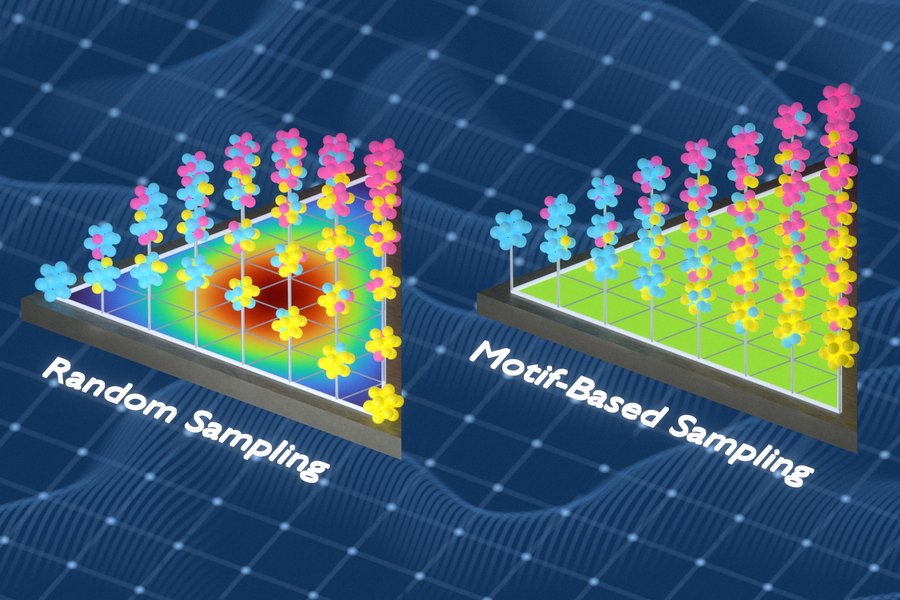
MIT researchers created a technique that captures chemical arrangements across materials to improve predictions of how metal alloys and other complex materials will behave. This figure compares a random sampling approach to the researchers’ new motif-based sampling.Credit: Courtesy of the researchers
<関連情報>
- https://news.mit.edu/2026/better-way-to-model-metal-alloys-behavior-0619
- https://www.science.org/doi/10.1126/sciadv.aea9951
- https://www.pnas.org/doi/10.1073/pnas.2322962121
組成全体にわたる合金モデリングのための機械学習の可能性 Machine learning potentials for modeling alloys across compositions
Killian Sheriff, Daniel Z. Xiao, Yifan Cao, Lewis R. Owen, and Rodrigo Freitas
Science Advances Published:19 Jun 2026
DOI:https://doi.org/10.1126/sciadv.aea9951
Abstract
Materials properties depend strongly on chemical composition, i.e., the relative amounts of each chemical element. Changes in composition lead to entirely different chemical arrangements, which vary in complexity from perfectly ordered (i.e., stoichiometric compounds) to completely disordered (i.e., solid solutions). Accurately capturing this range of chemical arrangements remains a major challenge, limiting the predictive accuracy of machine learning potentials (MLPs) in materials modeling. Here, we combine information theory and machine learning to optimize the sampling of chemical motifs and design MLPs that effectively capture the behavior of metallic alloys across their entire compositional and structural landscape. The effectiveness of this approach is demonstrated by predicting the compositional dependence of various materials properties—including stacking-fault energies, short-range order, heat capacities, and phase diagrams—for the AuPt and CuAu binary alloys, the ternary CrCoNi, and the TiTaVW high-entropy alloy. Extensive comparison against experimental data demonstrates the robustness of this approach in enabling materials modeling with high physical fidelity.
金属合金における化学的短距離秩序の定量化 Quantifying chemical short-range order in metallic alloys
Killian Sheriff, Yifan Cao, Tess Smidt, and Rodrigo Freitas
Proceedings of the National Academy of Sciences Published:June 13, 2024
DOI:https://doi.org/10.1073/pnas.2322962121
Significance
Metallic alloys underpin many technological advancements. In these materials two or more chemical elements are mixed together, often forming phases in which elements are spread out in an almost random manner. The tendency of certain chemical motifs to be more common than others—known as chemical short-range order—renders alloys “slightly less random than completely random.” Short-range order affects the stability and properties of metals, besides being the harbinger of important phenomena such as phase transitions. In this work, we present an approach for the complete characterization of short-range order, atom-by-atom, thereby advancing the quantitative understanding of metallic alloys, and paving the way for the rigorous incorporation of this phenomenon into mechanical and thermodynamic models.
Abstract
Metallic alloys often form phases—known as solid solutions—in which chemical elements are spread out on the same crystal lattice in an almost random manner. The tendency of certain chemical motifs to be more common than others is known as chemical short-range order (SRO), and it has received substantial consideration in alloys with multiple chemical elements present in large concentrations due to their extreme configurational complexity (e.g., high-entropy alloys). SRO renders solid solutions “slightly less random than completely random,” which is a physically intuitive picture, but not easily quantifiable due to the sheer number of possible chemical motifs and their subtle spatial distribution on the lattice. Here, we present a multiscale method to predict and quantify the SRO state of an alloy with atomic resolution, incorporating machine learning techniques to bridge the gap between electronic-structure calculations and the characteristic length scale of SRO. The result is an approach capable of predicting SRO length scale in agreement with experimental measurements while comprehensively correlating SRO with fundamental quantities such as local lattice distortions. This work advances the quantitative understanding of solid-solution phases, paving the way for the rigorous incorporation of SRO length scales into predictive mechanical and thermodynamic models.

