2026-07-06 中国科学院(CAS)
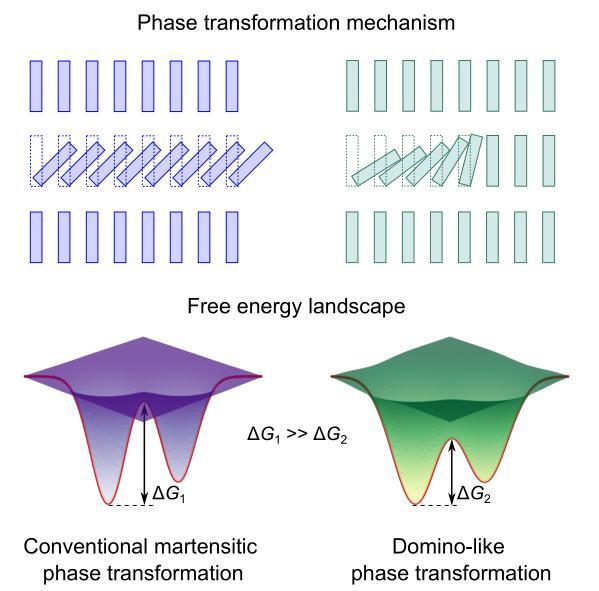
Comparison of conventional martensitic and domino-like phase transformations. (Image by IMR)
<関連情報>
- https://english.cas.cn/newsroom/research-news/202607/t20260702_1175219.shtml
- https://www.pnas.org/doi/10.1073/pnas.2528037123
1次元ドミノ型相転移により2次元MoTe2における材料プログラミングが可能になる 1D domino-like phase transformation enables material programming in 2D MoTe2
Xiangyang Liu, Mingyi Chen, Peitao Liu, +2 , and Xing-Qiu Chen
Proceedings of the National Academy of Sciences Published:June 29, 2026
DOI:https://doi.org/10.1073/pnas.2528037123
Significance
Solid–solid phase transformation represents a pivotal route for tailoring material properties, particularly in polymorphic systems such as transition metal dichalcogenides. Nevertheless, the semiconducting-to-metallic transformation in these compounds remains controversial. While traditionally described as a conventional martensitic process, its kinetics have eluded direct observation, and the high energy barrier challenges its feasibility. Using advanced molecular dynamics simulations, we identify that transformation in monolayer MoTe2 proceeds in a one-dimensional, domino-like manner, exhibiting features of both martensitic and reconstructive transformations. Guided by this refreshed understanding, we demonstrate controlled phase patterning that dramatically enhances nonlinear optical responses and enables rapid ferroelastic switching. This work redefines the understanding of phase transformations in two-dimensional materials and establishes a design framework for programmable electronic and optoelectronic devices.
Abstract
Phase transformation is a fundamental phenomenon in nature, vital for both the scientific understanding and industrial applications of materials. The emergence of two-dimensional (2D) materials introduces new physical attributes that challenge traditional phase transformation theories due to their reduced dimensionality. In monolayer transition metal dichalcogenides (TMDCs), phase transformation is typically described as a martensitic process characterized by concerted atomic displacements. Nevertheless, the large energy barrier in 2D TMDCs makes such transformations difficult to realize, posing a substantial challenge to the experimental research on the microscopic mechanism, and hindering the precise regulation of material properties. To address this, we investigate the phase transformation in monolayer MoTe2 through advanced molecular dynamics simulations accelerated by deep learning potential. Our results uncover that the phase transformation proceeds in a one-dimensional (1D), domino-like manner, exhibiting features of both martensitic and reconstructive transformations. This unique mechanism provides tunability over the process, enabling remarkably enhanced nonlinear optical responses and rapid electrical switching. This work advances current phase transformation understanding and provides perspectives for the phase engineering in other 2D materials.