2026-04-22 英国研究イノベーション機構(UKRI)
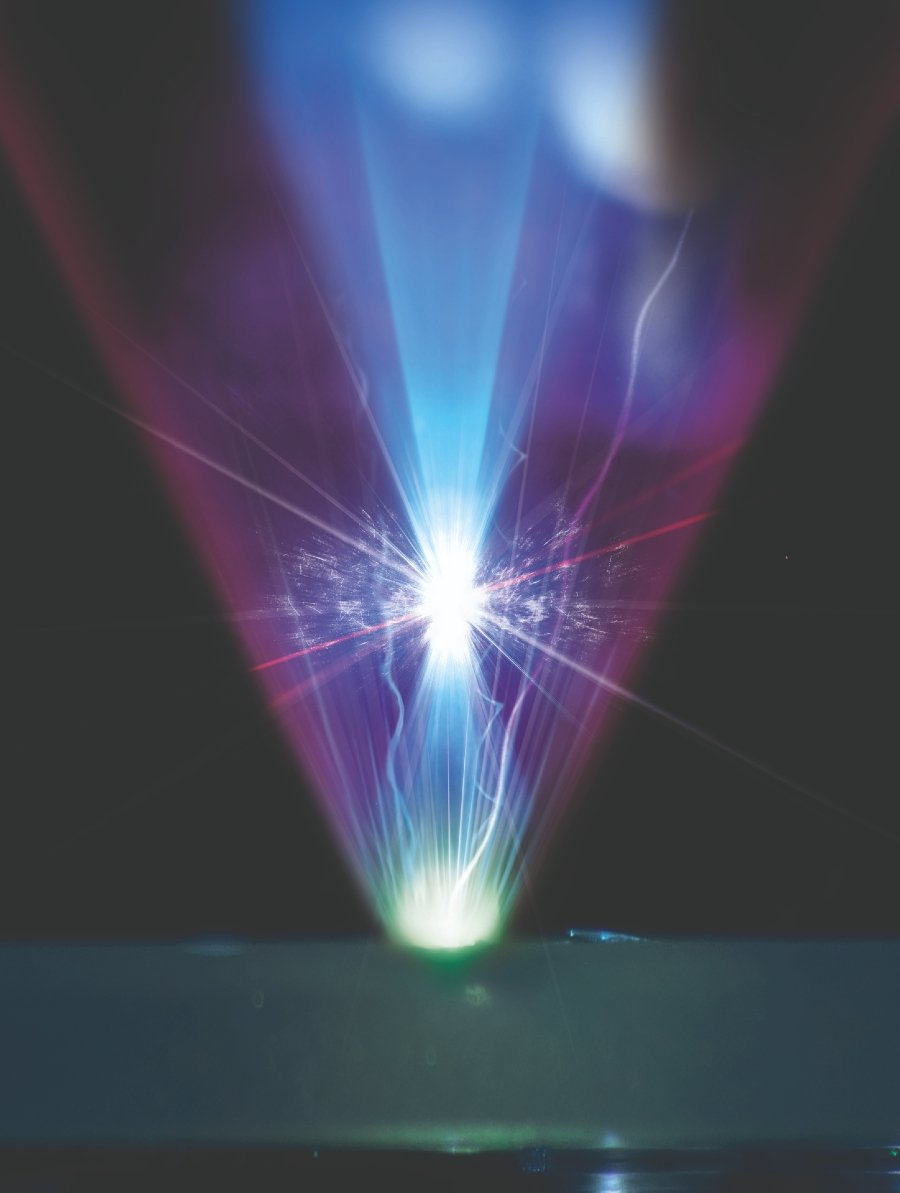
Coherent harmonic focus (CHF) generation. The laser is focused on a target, the reflected
purple beam forms a CHF of extreme intensity that generates matter from light. Photos of
the interaction are combined with an artist’s interpretation of the CHF. Credit: Timmis et al.
2026.
<関連情報>
- https://www.ukri.org/news/scientists-unlock-new-route-to-extreme-light-intensification/
- https://www.nature.com/articles/s41586-026-10400-2
Efficiency-optimized relativistic plasma harmonics for extreme fields
Robin J. L. Timmis,Colm R. J. Fitzpatrick,Jonathan P. Kennedy,Holly M. Huddleston,Elliott Denis,Abigail James,Chris Baird,Dan Symes,David McGonegle,Eduard Atonga,Heath Martin,Jeremy Rebenstock,John Neely,Jordan Lee,Joshua Redfern,Nicolas Bourgeois,Oliver Finlay,Rusko Ruskov,Sam Astbury,Steve Hawkes,Zixin Zhang,Matt Zepf,Karl Krushelnick,Edward Gumbrell,… Peter Norreys
Nature Published:22 April 2026
DOI:https://doi.org/10.1038/s41586-026-10400-2
Abstract
Bright harmonic radiation from relativistically oscillating laser plasmas offers a direct route for generating extreme electromagnetic fields. Theory predicts that under optimized conditions, the plasma medium can support strong spatiotemporal compression of laser energy in a coherent harmonic focus (CHF), delivering intensity boosts many orders of magnitude greater than the incident driving laser pulse1,2,3,4. Although diffraction-limited performance5 (spatial compression) and attosecond phase locking6,7,8 (temporal compression) have been demonstrated experimentally, efficient coupling of relativistically intense laser pulse energy into the emitted harmonic cone has not been realized so far. Here we demonstrate that this highly nonlinear interaction can be tailored to deliver the maximum conversion efficiencies predicted from simulations. By fine-tuning the temporal profile of the driving laser on sub-picosecond (<10−12 s) timescales, energies >9 mJ between the 12th and 47th harmonics are observed. These results are in agreement with the theoretically expected efficiency dependence on harmonic order, verifying that optimal conditions have been achieved in the generation process. This is the important final element required to achieve the expected intensity boosts from a CHF in experiments. Although obtaining spatiotemporal compression and optimal efficiency simultaneously remains challenging, the path to realizing extreme optical field strengths approaching the critical field of quantum electrodynamics (the Schwinger limit at >1016 V cm−1 or >1029 W cm−2) is now open, permitting all-optical studies of the quantum vacuum and new frontiers for intense attosecond science.