2026-03-27 ジョージア工科大学
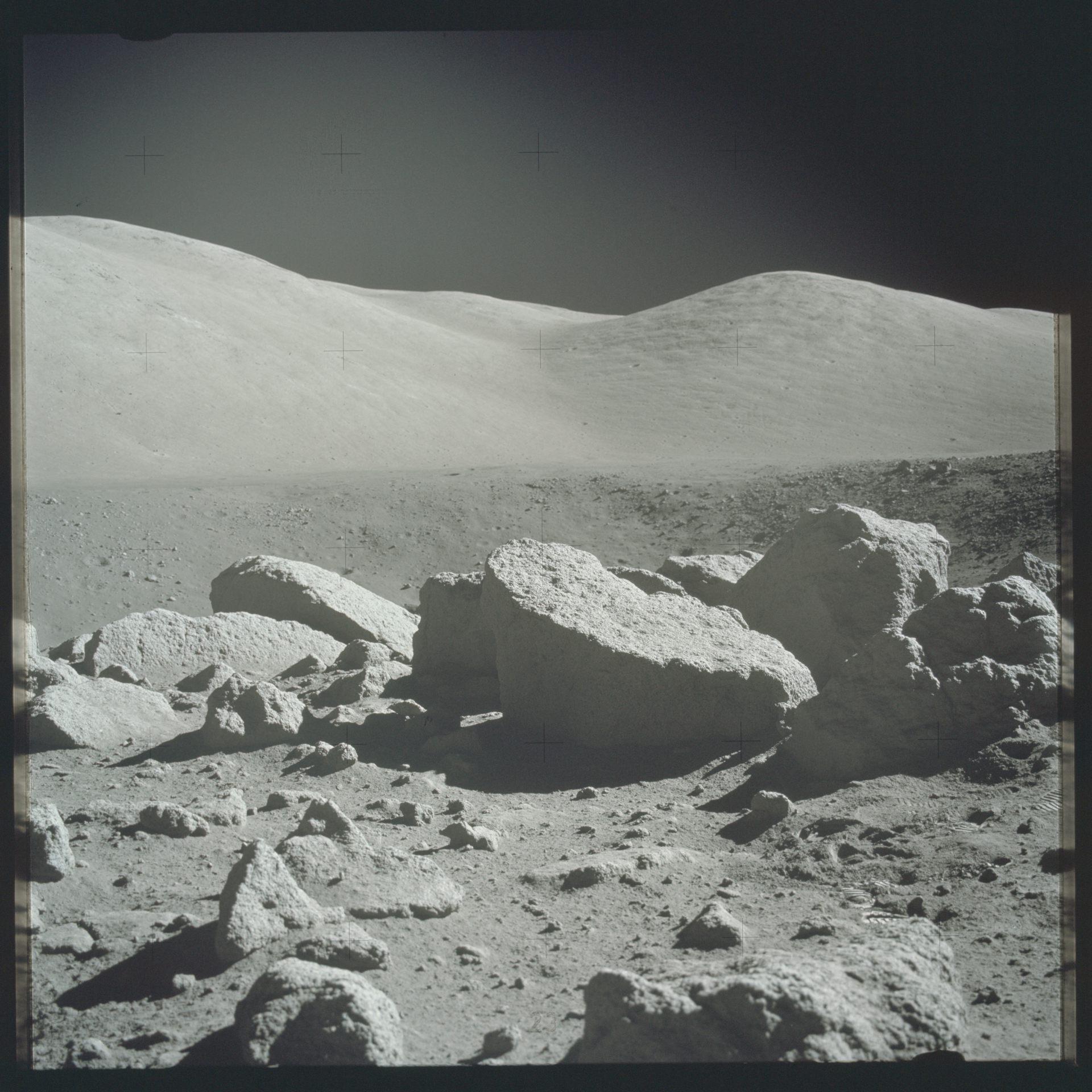
The Camelot crater in the Moon’s Taurus-Littrow Valley is where the sample containing trivalent titanium was found. NASA/Apollo 17: AS17-145-22159
<関連情報>
- https://research.gatech.edu/new-study-measures-titanium-apollo-rock-uncover-moons-early-chemistry
- https://www.nature.com/articles/s41467-026-69770-w
高チタン含有月面イルメナイト中の三価チタン Trivalent titanium in high-titanium lunar ilmenite
Advik D. Vira,Katherine D. Burgess,Emily C. First,Mengkun Tian,Keyes M. Eames,Roshan S. Trivedi,Gabriella K. Dotson,Dean M. Kim,Tyler P. Farr,Harrison Lisabeth,Nobumichi Tamura,Emma R. Livernois,Brant M. Jones,Thomas M. Orlando,Zhigang Jiang & Phillip N. First
Nature Communications Published:27 March 2026
DOI:https://doi.org/10.1038/s41467-026-69770-w
Abstract
Lunar mare basalts are often rich in titanium, hosted predominantly within the mineral ilmenite (Fe2+Ti4+O3). Here, we examine ilmenite in a ~ 3.8 billion-year-old mare basalt (Apollo rock 75035) using high-resolution electron microscopy and electron energy loss spectroscopy. A key finding is that 75035 ilmenite is itself enriched in Ti, beyond the end member of the conventional solid solution series. Using energy loss near-edge spectroscopy, we determine that the excess Ti is trivalent, with Ti3+ accounting for 13% of the total Ti content. This discovery confirms the presence of trivalent Ti in lunar ilmenite, long hypothesized based on the Moon’s reducing environment. Accounting for the change in implied stoichiometry, a review of literature data suggests that Ti3+ may be present in ilmenite across a wide range of lunar samples. We extrapolate known relationships from the literature to connect Ti3+ to redox conditions, estimating the oxygen fugacity during crystallization of 75035 to be below the iron-wüstite buffer, ΔIW≤ − 1.6. Further quantifying the relationship between Ti valence state and oxygen fugacity would allow Ti3+-bearing ilmenite to serve as an oxybarometer able to access the reducing conditions found on many planetary bodies.