2026-04-21 気象庁気象研究所,北海道大学,名古屋大学
<関連情報>
- https://www.mri-jma.go.jp/Topics/R08/080421/080421_press.html
- https://www.mri-jma.go.jp/Topics/R08/080421/080421_press.pdf
- https://www.nature.com/articles/s41612-026-01389-6
北極の水分輸送の変化に伴う海氷融解と大陸湿潤の相互関係 Interlinks between sea-ice melting and continental wetting under a changing Arctic moisture transport
Tetsu Nakamura,Tomonori Sato,Yoshiki Fukutomi & Tetsuya Hiyama
npj Climate and Atmospheric Science Published: 21 April 2026
DOI:https://doi.org/10.1038/s41612-026-01389-6
Abstract
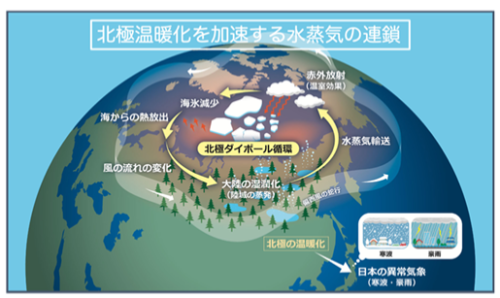
Abrupt Arctic warming has profound implications for both polar and mid-latitude climates, with moisture transport playing a central role in Arctic amplification. Using a tagged water vapor transport model driven by three reanalysis datasets, we quantify seasonal Arctic moisture transport during 1980–2024 and evaluate the inter-dataset spread. Robust features across all datasets indicate that summer moistening is primarily caused by increased inflow of continental moisture, while autumn moistening is dominated by local evaporation over the Arctic Ocean. Although evaporation trends exhibit substantial inter-reanalysis discrepancies, the associated summer moisture transport into the Arctic is remarkably consistent across datasets, underscoring the dominant role of circulation changes. Simulations further show that sea ice retreat induces the Arctic Dipole pattern that reinforces moisture transport and radiative feedbacks, suggesting a previously unrecognized feedback loop. Our findings highlight both the robust and uncertain components of the Arctic moisture cycle and emphasize the need to better constrain surface evaporation in Arctic climate modeling.