2026-05-15 京都大学
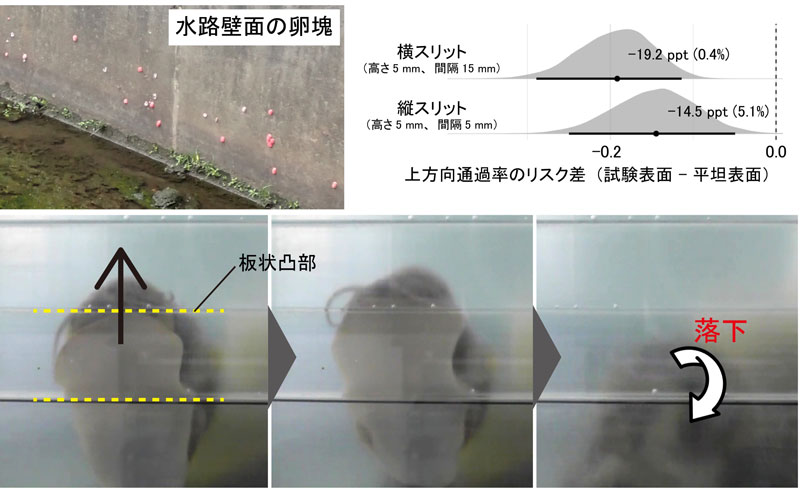
壁面の横スリット表面を歩行中に落下するスクミリンゴガイ(撮影・作成:橘悟)
<関連情報>
- https://www.kyoto-u.ac.jp/ja/research-news/2026-05-15-2
- https://scijournals.onlinelibrary.wiley.com/doi/10.1002/ps.70926
スクミリンゴガイにおける表面形状の歩行抑制効果 Walking inhibition effect of different surfaces in apple snail, Pomacea canaliculata
Satoru Tachibana, Seiya Nishikawa
Pest Management Science Published: 14 May 2026
DOI:https://doi.org/10.1002/ps.70926
Abstract
BACKGROUND
The apple snail Pomacea canaliculata causes significant damage to the agricultural industry, primarily in Asia, by feeding on rice leaves and other crops. Although it has been designated as a priority invasive species in Japan and various measures to control it have been implemented, its range expanded to 35 prefectures by 2022. Though chemical control methods like pesticides and collection of adult snails are common, the efficiency is low due to the large number of eggs laid. This study investigated surface structures that inhibit the vertical movement of apple snails, as a new non-chemical control method, reducing their ability to climb emergent structures where oviposition occurs.
RESULTS
Laboratory experiments involving walking on differently shaped surfaces revealed several effective designs, such as slits and thorns, for the prevention of snail movement. Surfaces featuring horizontal (5 mm high × 15 mm interval) and vertical (5 mm high × 5 mm interval) slits strongly reduced upward passage to approximately 0.4 and 5.1%, respectively, compared with that on the control surface at 19.7% (risk differences: −19.2 and −14.5 percentage points).
CONCLUSION
This study presented the structures to be designed and the verification methods possible in the laboratory. Surface structures that inhibit walking can be applied as a new control method for capture traps and concrete waterways. © 2026 Society of Chemical Industry.