2026-05-15 テキサスA&M大学

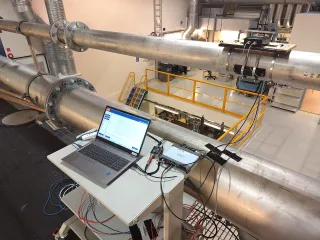
Texas A&M researchers are developing next-generation optical sensors that can analyze data in real time, paving the way for faster, more efficient surgical robots and space exploration.Credit: Leonel Contreras Jr./Texas A&M University College of Engineering
<関連情報>
- https://stories.tamu.edu/news/2026/05/15/smart-optical-sensors-pave-the-way-for-real-time-decision-making/
- https://www.nature.com/articles/s44460-026-00065-9
超小型インテリジェントビジョン向けエレクトロクロミックハイパースペクトル埋め込み Electrochromic hyperspectral embedding for ultracompact intelligent vision
Ran Li,Chaoyi He,Yi Huang,Enzi Zhai,Vinod K. Sangwan,Jingyi Zou,Kevin St. Luce,Jianzhou Cui,Rex Kim,Roland Liu,Zhixing Wang,Xi Ling,Helen Xie,Xu Zhang,Mark C. Hersam,Qiangfei Xia,Linda Katehi & Yuxuan Cosmi Lin
Nature Sensors Published:05 May 2026
DOI:https://doi.org/10.1038/s44460-026-00065-9
Abstract
The rapid proliferation of edge-computing applications, including autonomous vehicles, wearable electronics and mobile robotics, is driving demand for compact vision systems capable of real-time intelligent processing under strict energy and latency constraints. Conventional imaging architectures, however, separate sensing from computation, producing large data streams that increase power consumption and system complexity. Here we report electrochromic hyperspectral embedding, an in-sensor computing framework that adaptively compresses spectral information at the pixel level. Our approach exploits electrically tunable photocurrent responses in electrochromic photodetectors, enabling each pixel to selectively encode its most task-relevant spectral components before readout. The resulting low-dimensional outputs interface directly with lightweight memristor-based analogue computing hardware for efficient inference. Compared with conventional artificial intelligence vision systems, electrochromic hyperspectral embedding reduces data transmission by more than an order of magnitude while maintaining high classification accuracy, offering a materials-to-system pathway towards compact, high-speed and energy-efficient intelligent vision for scalable edge applications.