
2025-10-14 分子科学研究所
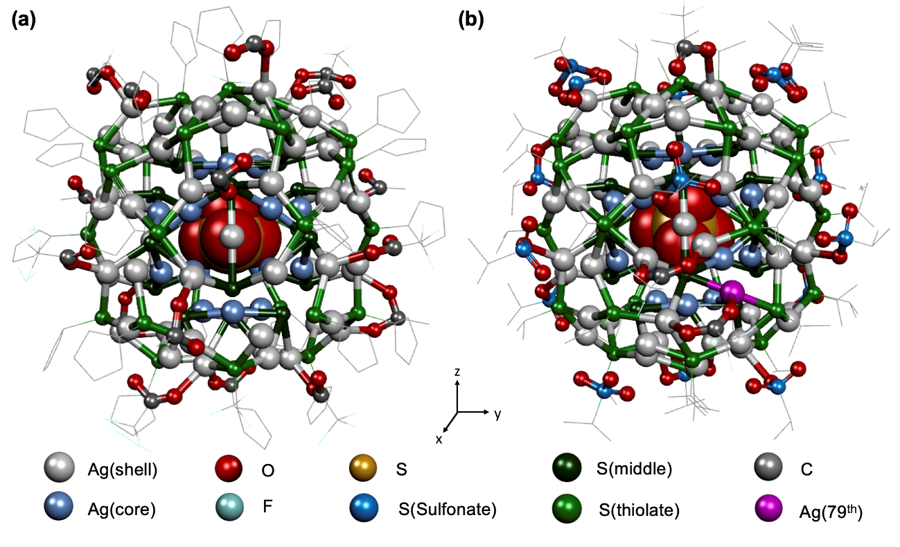
図1. (a)Ag78と(b)Ag79の構造比較。Ag78では外殻に60個のAg原子があり、C3対称性を形成。Ag79では外殻に61個のAg原子があり、C3対称性が崩壊。
<関連情報>
銀原子の過剰取り込みによる高核銀ナノクラスターの光ルミネッセンスの誘発 Triggering Photoluminescence in High-Nuclear Silver Nanoclusters via Extra Silver Atom Incorporation
Aoi Akiyama,Sakiat Hossain,Sourav Biswas,Takafumi Shiraogawa,Pei Zhao,Mana Nakamoto,Daiji Ogata,Tokuhisa Kawawaki,Yoshiki Niihori,Junpei Yuasa,Masahiro Ehara,and Yuichi Negish
Journal of the American Chemical Society Published: September 30, 2025
DOI:https://doi.org/10.1021/jacs.5c10289
Abstract
Photoluminescence (PL) in silver (Ag) nanoclusters (NCs) is intrinsically linked to their structural architecture, yet their low quantum yield at room-temperature hinders practical applications. Although various strategies have been explored to enhance the PL efficiency of Ag NCs, their effectiveness in high-nuclear Ag NCs remains largely uncertain. Here, we demonstrate a 77-fold enhancement in room-temperature PL quantum yield by modulating both radiative and nonradiative decay pathways in high-nuclear Ag NCs. A comparative study of two anion-templated Ag NCs, differing by a single Ag atom in the outermost shell, reveals that this substitution lowers structural symmetry, thereby increasing the radiative decay rate. This structural modification is facilitated by the alterations in ligands and their coordination environment, which simultaneously suppress atomic fluctuations and reduce the nonradiative decay component. Furthermore, theoretical investigations corroborate these findings, indicating that the incorporation of an additional Ag atom modifies the electronic distribution, thereby influencing the PL characteristics and ultimately altering the emission mechanism. These insights provide a deeper understanding of the structure–property relationship in high-nuclear Ag NCs and offer a rational strategy for enhancing their luminescence efficiency for potential applications.
