2026-05-21 沖縄科学技術大学院大学
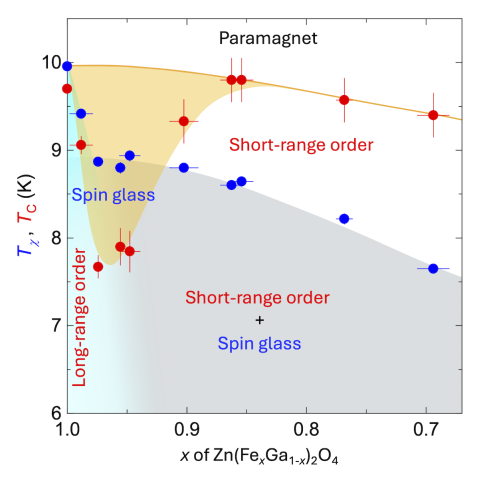
ガリウム(Ga)による結晶ドーピングにより鉄(Fe)濃度が低下するにつれて、亜鉛フェライトにおける秩序とスピングラスがどのように並行して変化するかを示した図。磁化率(Tx)および熱容量(Tc)を用いて評価している。最も純度の高い状態では、結晶は反強磁性(長距離)秩序(水色の領域)を示すが、これが急激に低下し、短距離秩序が支配的となる。興味深いことに、短距離秩序が最初に低下する段階でスピングラス挙動(灰色の領域)が現れる。これは、短距離秩序も長距離秩序もスピングラスの発現条件ではないことを示唆している。© ドロノバほか(2026年)
<関連情報>
- https://www.oist.jp/ja/news-center/news/2026/5/21/complete-evolution-spin-glass-order-chaos
- https://www.cell.com/matter/fulltext/S2590-2385(26)00192-X
スピングラスと短距離秩序の間の時間的および空間的分離 Temporal and spatial separations between spin glass and short-range order
Margarita G. Dronova ∙ Feng Ye ∙ Zachary J. Morgan ∙ Yishu Wang ∙ Yejun Feng
Matter Published:May 21, 2026
DOI:https://doi.org/10.1016/j.matt.2026.102829
Progress and potential
Among all material-related topics, spin glass might best exemplify the dictum that researchers approach an experimental subject like blind men to an elephant. After over 50 years of interest, the material’s picture of spin glass remains opaque, despite most physical probes having been utilized. Taking a page from the paradigm of quantum criticality, here we explore how the spin glass emerges from an ordered parent state. From a well-characterized antiferromagnet in the clean limit, a great amount of experimental endeavor was taken to introduce chemical disorder only to the magnetic sublattice. This emergent spin glass allows us to differentiate it from both long- and short-range order and further reveal a competition between the latter two. Our emphasis on the materials science’s perspective of disorder expands a dimension of the parameter space in practice, leading to new approaches toward other outstanding exotic phases of quantum magnetism.
Highlights
- An evolution from long- to short-range order driven by a minimal amount of disorder
- Critical fluctuations vs. static spin correlation revealed by diffuse scattering
- Spin glass is composed of single, uncorrelated spins
- The short-range order has many instabilities, while the long-range order has one
Summary
Broken-symmetry-induced order parameters account for many phenomena in physics. For spin glasses, this framework dictates the theoretical construction, whereas experiments have only established dynamical behaviors but not the physical entity. Experimental techniques have limitations when the spin glass is probed as an isolated state. Here, we create an evolution from a long-range order using well-controlled non-magnetic substitution on a sublattice. Neutron magnetic diffuse scattering of pico-second timescale reveals that the dynamics of short- and long-range order formation are not affected by disorder, but their spatial ranges are. Across all specimens, the inflection point of spin correlation length’s temperature dependence fully matches with the peak in heat capacity, while spin glass can freeze at millisecond timescale either above or below this characteristic temperature of spin-order formation. Our results identify the spin glass as single, uncorrelated spins at domain walls between spin clusters, and an uncorrelated coexistence of the two.