20206-05-08 シカゴ大学(Chicago)

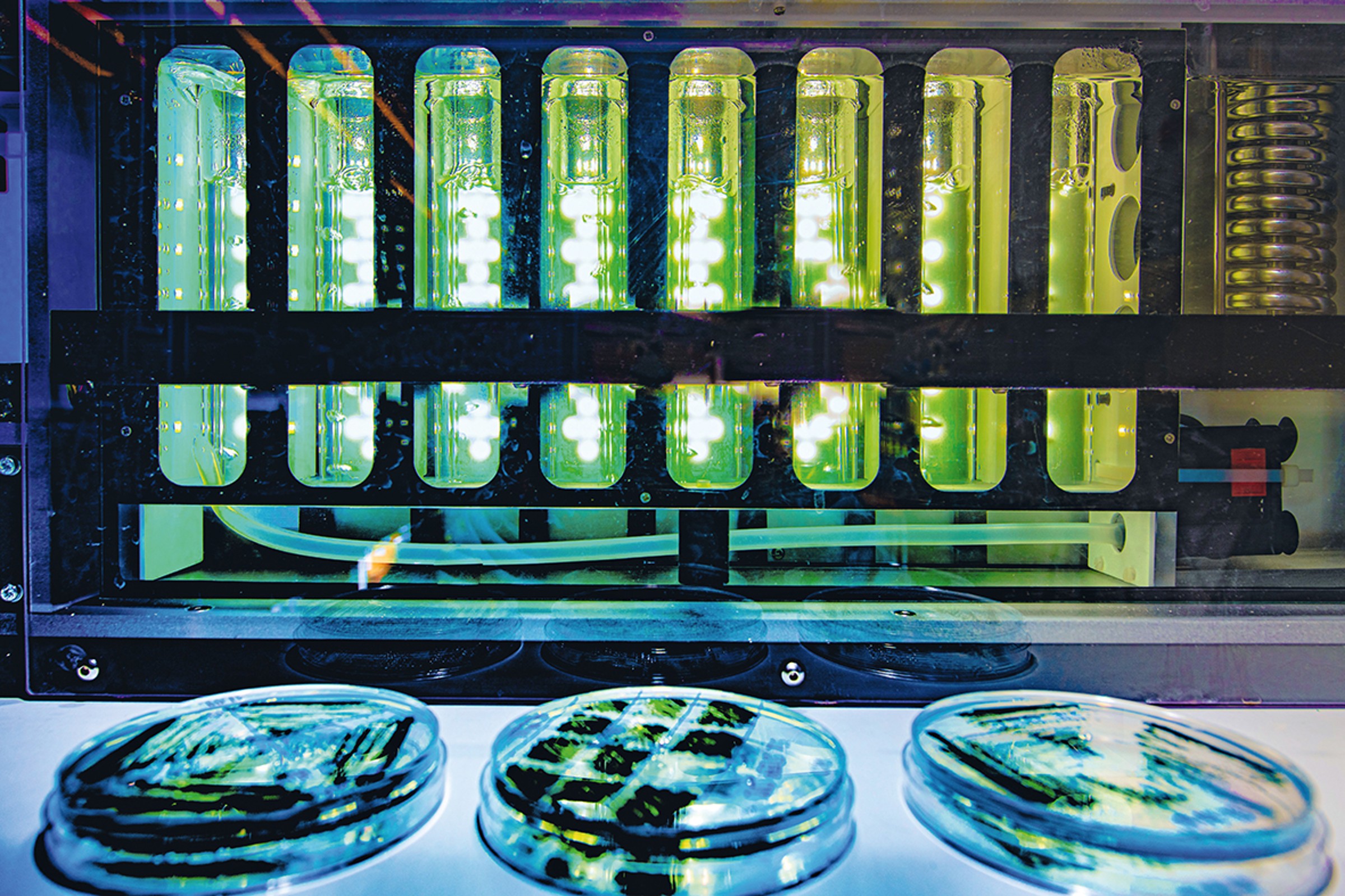
A new technique allows researchers to more quickly create new molecules by easily swapping nitrogen atoms in the place of carbonyl groups, which may help speed the process of drug discovery.Photo by Bart Harris
<関連情報>
- https://news.uchicago.edu/story/uchicago-chemists-invent-new-way-swap-nitrogen-molecules
- https://www.science.org/doi/10.1126/science.aef0610
- https://www.science.org/doi/10.1126/science.abl7854
カルボニル原子と窒素原子の交換によって可能になったsp3リッチな足場における窒素の走査 Scanning nitrogen in sp3-rich scaffolds enabled by carbonyl-to-nitrogen atom swap
Zining Zhang, Zhehan Liang, Rong Ye, and Guangbin Dong
Science Published:30 Apr 2026
DOI:https://doi.org/10.1126/science.aef0610
Editor’s summary
Cyclic fragments incorporating nitrogen are ubiquitous components of pharmaceuticals. Recently, chemists have introduced a variety of editing techniques to modify these frameworks one atom at a time, mostly focusing on unsaturated rings. Two groups now report complementary methods to diversify saturated cyclic amines (see the Perspective by Wu). Li et al. used mild oxidation to pull an exocyclic nitrogen into a carbon ring. Zhang et al. replaced carbonyl groups embedded in rings with nitrogen, taking advantage of a companion reaction that can readily migrate the carbonyl around the framework beforehand. —Jake S. Yeston
Abstract
Medicinal chemistry campaigns routinely require access to series of saturated nitrogen heterocycle (SNH)–based analogs that place nitrogen at different positions to probe structure-activity relationships. However, systematic preparation of N-positional variants remains synthetically burdensome. In this work, we report a strategy for nitrogen scanning in sp3-rich scaffolds enabled by the exchange of a carbonyl group with an amine moiety, formally achieving a carbonyl-to-nitrogen (CO-to-N) atom swap. Because ketone positional isomers can be readily obtained through carbonyl transposition or carbon-hydrogen oxidation from a common carbocyclic precursor, the CO-to-N atom swap greatly streamlines the preparation of SNH positional analogs and obviates the need for multiple de novo syntheses. The CO-to-N reaction exhibits exceptional functional group compatibility and generality, which makes it well suited for late-stage modification of complex bioactive molecules and for isotopic labeling.
トリフラートを介したαアミノ化によるカルボニル1,2-転位 Carbonyl 1,2-transposition through triflate-mediated α-amination
Zhao Wu, Xiaolong Xu, Jianchun Wang, and Guangbin Dong
Science Published:4 Nov 2021
DOI:https://doi.org/10.1126/science.abl7854
Careful choreography for a ketone shift
Chemists devote tremendous effort to the precise placement of oxygens in molecular frameworks. Wu et al. report a convenient method to shift the oxygen in a carbonyl group to an adjacent carbon center. After activation of the oxygen to an alkenyl triflate, cooperative catalysis by palladium and norbornene adds nitrogen to the neighboring carbon while displacing the triflate with hydride. Hydrolysis then produces the desired shifted ketone. The protocol is well suited to late-stage variation of complex molecules during drug optimization. —JSY
Abstract
To date, it remains challenging to selectively migrate a carbonyl oxygen within a given molecular scaffold, especially to an adjacent carbon. In this work, we describe a simple one- or two-pot protocol that transposes a ketone to the vicinal carbon. This approach first converts the ketone to the corresponding alkenyl triflate, which can then undergo the palladium- and norbornene-catalyzed regioselective α-amination and ipso-hydrogenation enabled by a bifunctional hydrogen and nitrogen donor. The resulting “transposed enamine” intermediate can subsequently be hydrolyzed to produce the 1,2-carbonyl–migrated product. This method allows rapid access to unusual bioactive analogs through late-stage functionalization.