2026-05-26 京都大学
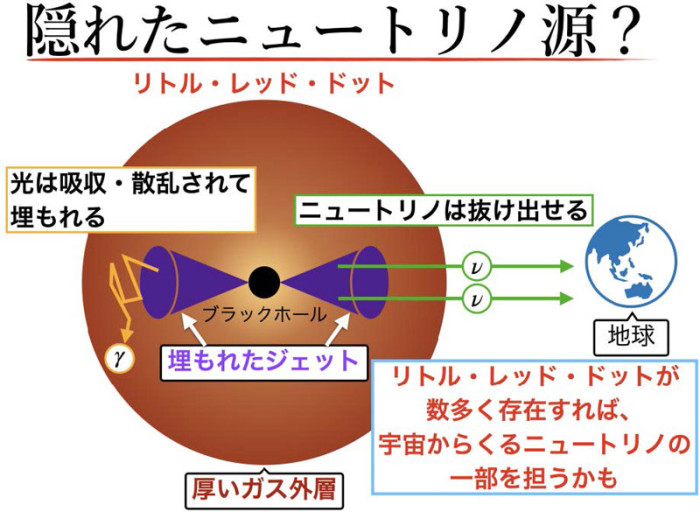
リトル・レッド・ドットの中心には、厚いガス外層に包まれたブラックホールが存在する可能性がある。この環境では、中心付近で生じた光はガス中で吸収・散乱されて埋もれる一方、ニュートリノは物質とほとんど反応せず外へ抜け出せる。リトル・レッド・ドットが数多く存在すれば、宇宙から届く高エネルギーニュートリノの一部を担っている可能性がある。作図:久世陸(基礎物理学研究所)
<関連情報>
- https://www.kyoto-u.ac.jp/ja/research-news/2026-05-26-1
- https://journals.aps.org/prd/abstract/10.1103/vbfz-ncxd
小さな赤い点は隠れたニュートリノ源 Little red dots as hidden neutrino sources
Riku Kuze, Kunihito Ioka, Kohta Murase, Shigeo S. Kimura, and Kohei Inayoshi
Physical Review D Published: 28 April, 2026
DOI: https://doi.org/10.1103/vbfz-ncxd
Abstract
Little red dots (LRDs) are enigmatic, compact, red galaxies at high redshift, ∼4–7, discovered by the James Webb Space Telescope. Broad emission lines in the absence of x-ray and radio counterparts suggest that they host accreting supermassive black holes embedded in dense gaseous envelopes. This black-hole-envelope configuration facilitates efficient photohadronic interactions and neutrino production. Remarkably, their observed source number density and luminosity are compatible with the energetics of the diffuse neutrino background. We consider that relativistic jets and outflows are launched from the black hole and propagate through low-density polar funnels within envelopes, where particle acceleration and neutrino emission occur. This leads to LRDs being effectively hidden sources. Our analytic and numerical calculations show that, in an optimistic scenario, LRDs can contribute ∼30% of the observed diffuse background at TeV–sub-PeV energies, predominantly through photomeson production. At high neutrino energies, ≳105.5 GeV, inverse-Compton cooling of muons modifies the resulting flavor ratio, providing a distinctive diagnostic for IceCube-Gen2 and other upcoming neutrino telescopes.