
2026-07-22 名古屋大学
<関連情報>
- https://www.nagoya-u.ac.jp/researchinfo/result/2026/07/ai-111.html
- https://onlinelibrary.wiley.com/doi/10.1002/ange.2731055
機械学習を用いたホウ素フリー狭帯域青色熱活性化遅延蛍光発光体の発見 Machine-Learning-Guided Discovery of Boron-Free Narrowband Blue Thermally Activated Delayed Fluorescence Emitters
Masaya Hagai, Jie Sun, Jun Hyeon Lee, Kazuhiro J. Fujimoto, Shigehiro Yamaguchi, Takuma Yasuda, Takeshi Yanai
Angewandte Chemie Published: 21 July 2026
DOI:https://doi.org/10.1002/ange.2731055
ABSTRACT
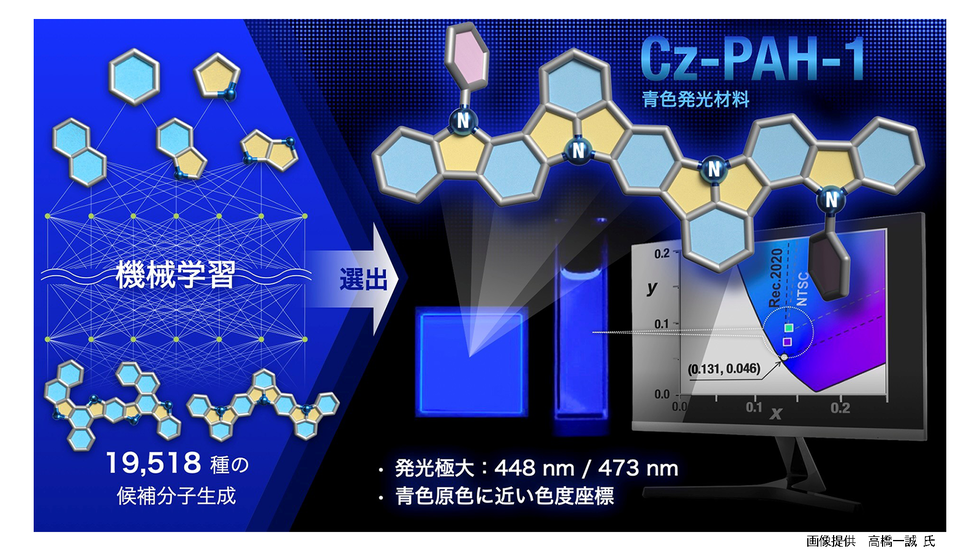
Thermally activated delayed fluorescence (TADF) emitters enable color-pure, energy-efficient organic light-emitting diodes (OLEDs), yet many ultra-narrowband designs rely on synthetically demanding boron incorporation. Here we discover boron-free emitters that reconcile a robust nitrogen-only polycyclic scaffold, Rec. 2020-grade pure-blue emission, and small singlet–triplet gaps (ΔEST) conducive to TADF. We enumerated 19 518 13-ring carbazole-containing polycyclic aromatic hydrocarbons (Cz-PAHs) and obtained quantum-chemical reference values for ∼1000 molecules: emission energies and ΔEST at S1-optimized geometries. A graph neural network enabled library-wide prediction and revealed a pronounced negative correlation between emission energy and ΔEST (R = −0.75), implicating configuration mixing in S1 and indicating that small-gap candidates are enriched in the pure-blue regime. Two selected Cz-PAH emitters were synthesized and display deep-blue, exceptionally narrow photoluminescence (full widths at half maximum 17–19 nm) with small experimental ΔEST (0.13–0.19 eV). OLEDs incorporating these emitters deliver narrowband blue electroluminescence (λEL 456 and 481 nm); device A reaches chromaticity coordinates of (0.139, 0.069), close to the Rec. 2020 blue primary, whereas the sensitized device D achieves a maximum external quantum efficiency of 35.2%. Collectively, this work expands the boron-free TADF design space and establishes an experimentally validated route to discovering high-color-purity organic emitters.
