2026-09-28 岡山大学,京都大学,近畿大学,東邦大学
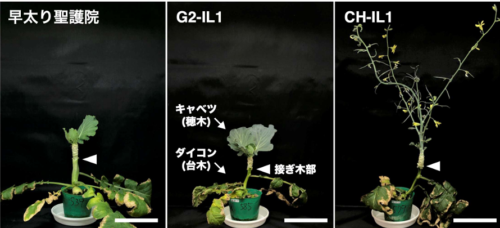
図1. 2つのFLC遺伝子の自然変異をもち、接ぎ木されたキャベツを開花させるCH-IL1(右)と、これらの変異を持たない‘早太り聖護院’(左)とG2-IL1(中央)。
<関連情報>
- https://www.okayama-u.ac.jp/tp/release/release_id1613.html
- https://www.okayama-u.ac.jp/up_load_files/press_r8/press20260928-1.pdf
- https://academic.oup.com/pcp/advance-article/doi/10.1093/pcp/pcag119/8812217
雑草ダイコン由来の破壊されたFLOWERING LOCUS Cアレルは、アブラナ科植物の接ぎ木を介した花芽誘導のための台木の開花能力を高める Disrupted FLOWERING LOCUS C alleles from weedy radish enhance the florigenic potential of rootstocks for graft-mediated floral induction in Brassicaceae
Ko Motoki, Saki Kobayashi, Kazusa Nishimura, Yu Kinoshita, Makoto Kashima, Koichiro Ushijima, Tanjuro Goto, Ken-ichiro Yasuba, Munetaka Hosokawa
Plant and Cell Physiology Published:28 September 2026
DOI:https://doi.org/10.1093/pcp/pcag119
Abstract
Graft-mediated floral induction is a classical yet promising breeding technique that accelerates seed production and shortens generation time in crops. However, its application remains limited to a few species because floral induction is often unstable. Even among florally induced rootstocks, grafted scions can differ in their flowering response depending on rootstock genotype, but the genetic basis of this variation remains unclear. Here, using a Brassicaceae grafting model, we investigated two early-bolting radish (Raphanus sativus) accessions differing in their ability to induce flowering. We focused on a significant difference in FLOWERING LOCUS T (FT) expression between these accessions and identified two quantitative trait loci (QTLs) associated with FT levels. Transcriptomic and genomic analyses revealed that both QTLs harbored previously unreported disrupted alleles of FLOWERING LOCUS C (FLC) homologs, key floral repressors involved in vernalization, which showed reduced expression and produced defective transcripts. Grafting experiments demonstrated that these disrupted FLC alleles enhanced floral induction, with RsFLC1 having a major effect. Our results indicate that the FT expression threshold required for graft-mediated floral induction is higher than that for rootstock flowering itself and that this threshold is reached when FLC-mediated repression is substantially reduced. These alleles were inferred to have originated from weedy radish (Raphanus raphanistrum), likely contributing to early flowering in disturbed environments. This study suggests that exploring genetic variations in FT expression is an effective strategy to develop highly florigenic rootstocks, thereby broadening the application of graft-mediated floral induction in crop breeding.