2026-09-16 中国科学院(CAS)
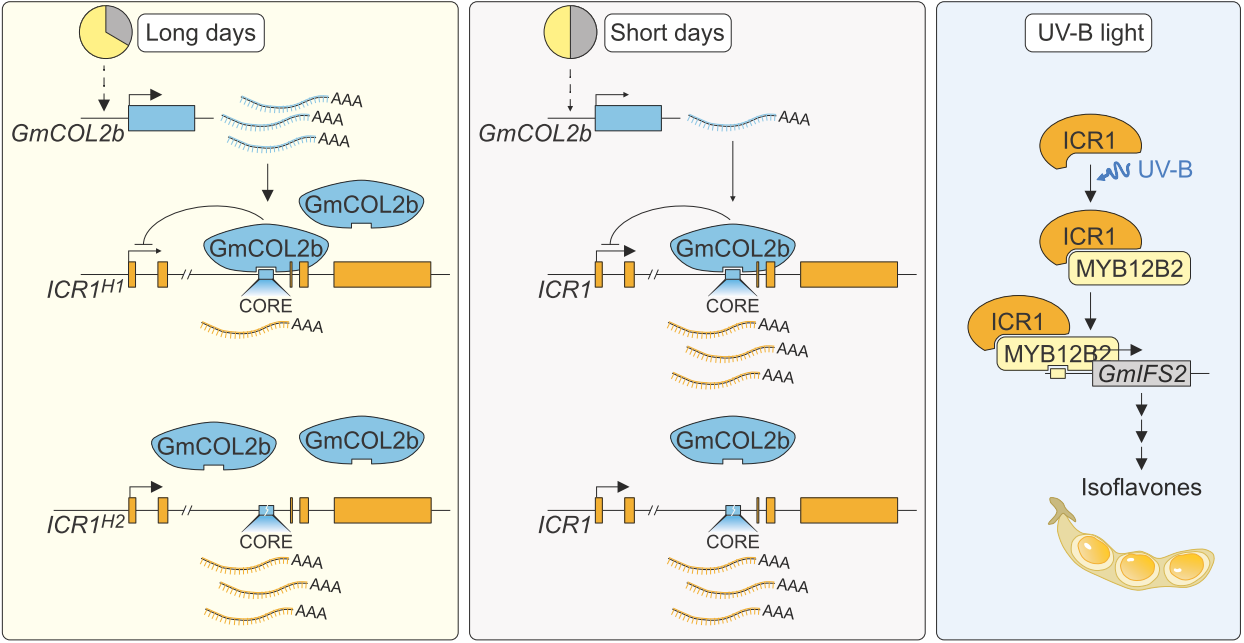
A molecular model illustrating the regulation of isoflavonoid accumulation in soybean seeds by the light environment. (Image by ZHANG Chunyu)
<関連情報>
- https://english.cas.cn/newsroom/research-news/202609/t20260917_1200809.shtml
- https://academic.oup.com/plcell/advance-article-abstract/doi/10.1093/plcell/koag268/8787425
光周期とUV-Bは、ダイズ種子におけるイソフラボノイド蓄積を制御するICR1の働きを調整する Photoperiod and UV-B orchestrate ICR1 to control seed isoflavonoid accumulation in soybean
Mingyang Jian, Huan Wu, Cuirong Tan, Yushuang Yao, Shu Liu, Yilong Hu, Xingliang Hou, Chunyu Zhang
The Plant Cell Published:07 September 2026
DOI:https://doi.org/10.1093/plcell/koag268
Abstract
Being sessile, plants optimize their physiological and metabolic processes in response to ambient environmental cues, such as light. However, the molecular mechanisms underlying environmental regulation of seed isoflavonoid biosynthesis in soybean remain largely elusive. Here, our genome-wide association study (GWAS) identifies Isoflavone Content Regulator 1 (ICR1), encoding a Regulator of Chromosome Condensation (RCC1) family protein, as a positive regulator of seed isoflavonoid accumulation in soybean. The CONSTANS (CO) homolog GmCOL2b directly suppresses ICR1 transcription by binding to a CORE cis-element. Notably, nature variations flanking the CORE sequence influence GmCOL2b binding affinity, thereby modulating ICR1 transcription and seed isoflavone content. We further demonstrate that photoperiod significantly affects seed isoflavone content, with short-day (SD) conditions promoting isoflavonoid accumulation by relieving GmCOL2b-mediated repression of ICR1, while UV-B radiation facilitates ICR1 protein accumulation. Subsequently, ICR1 interacts with GmMYB12B2 to enhance seed isoflavonoid biosynthesis. Our findings elucidate how soybean integrates environmental light signals, including photoperiod and UV-B signaling that vary across seasons or latitudes, to coordinate seed isoflavonoid biosynthesis, providing a valuable genetic resource for improving soybean nutritional quality.