2026-09-09 ロイヤルメルボルン工科大学(RMIT)
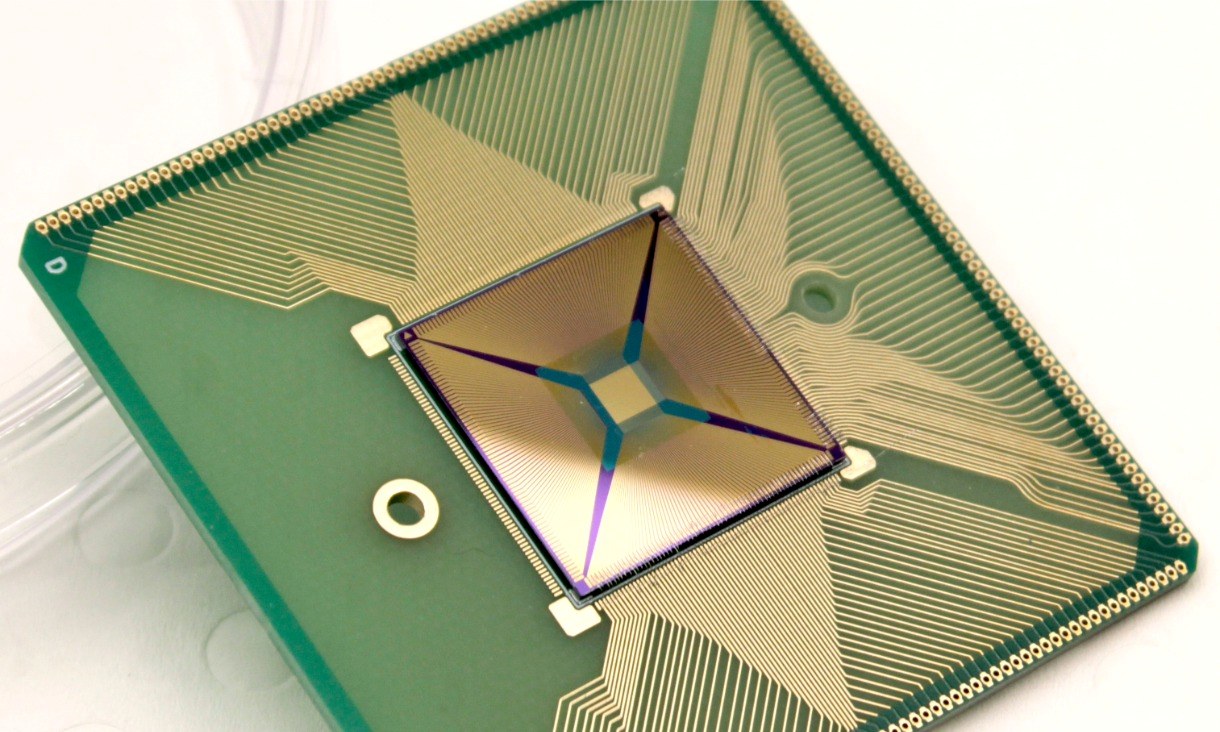
The sensing element at the heart of RMIT’s neuromorphic vision technology. Credit: RMIT University
<関連情報>
- https://www.rmit.edu.au/news/all-news/2026/sep/neuromorphic-bionic-eye
- https://advanced.onlinelibrary.wiley.com/doi/10.1002/admt.202401677
スパイクニューラルネットワークを用いたマシンビジョンアプリケーション向け光活性単層MoS₂ Photoactive Monolayer MoS2 for Spiking Neural Networks Enabled Machine Vision Applications
Thiha Aung, Sindhu Priya Giridhar, Irfan H. Abidi, Taimur Ahmed, Akram AI-Hourani, Sumeet Walia
Advanced Materials Technologies Published: 23 April 2025
DOI:https://doi.org/10.1002/admt.202401677
Abstract
Neuromorphic vision and information processing is a strongly emerging avenue for next-generation computing and sensing technologies. Spiking neural networks (SNNs), which mimic the spiking behavior of biological neurons, offer energy efficiency and biological plausibility. The leaky integrate-and-fire (LIF) model is a fundamental building block of SNNs, where incoming electrical pulses are integrated until threshold is reached, triggering a spike and resetting the membrane potential. While several photoactive materials have been explored for basic neural functionalities, the realization of accurate LIF neuron behavior including replication of membrane potential and its application in neuromorphic vision tasks remain unexplored. This work demonstrates the potential of chemical vapor deposition grown visible-active, atomically thin molybdenum disulfide (MoS2) monolayers in replicating the charging and discharging states of LIF neurons through their photoelectrical response. Gate voltage modulation is employed to swiftly reset the neuron, enabling the replication of LIF dynamics and fast system responsiveness. The key photoresponse parameters of MoS2 are embedded into SNN model that achieves 75% accuracy after 15 epochs for static tasks and 80% accuracy after 60 epochs for dynamic tasks. This demonstrates that the potential of photoactive 2D materials for SNNs, representing a step in the development of real-time, energy efficient neuromorphic computing.