

2026-10-02 兵庫県立大学
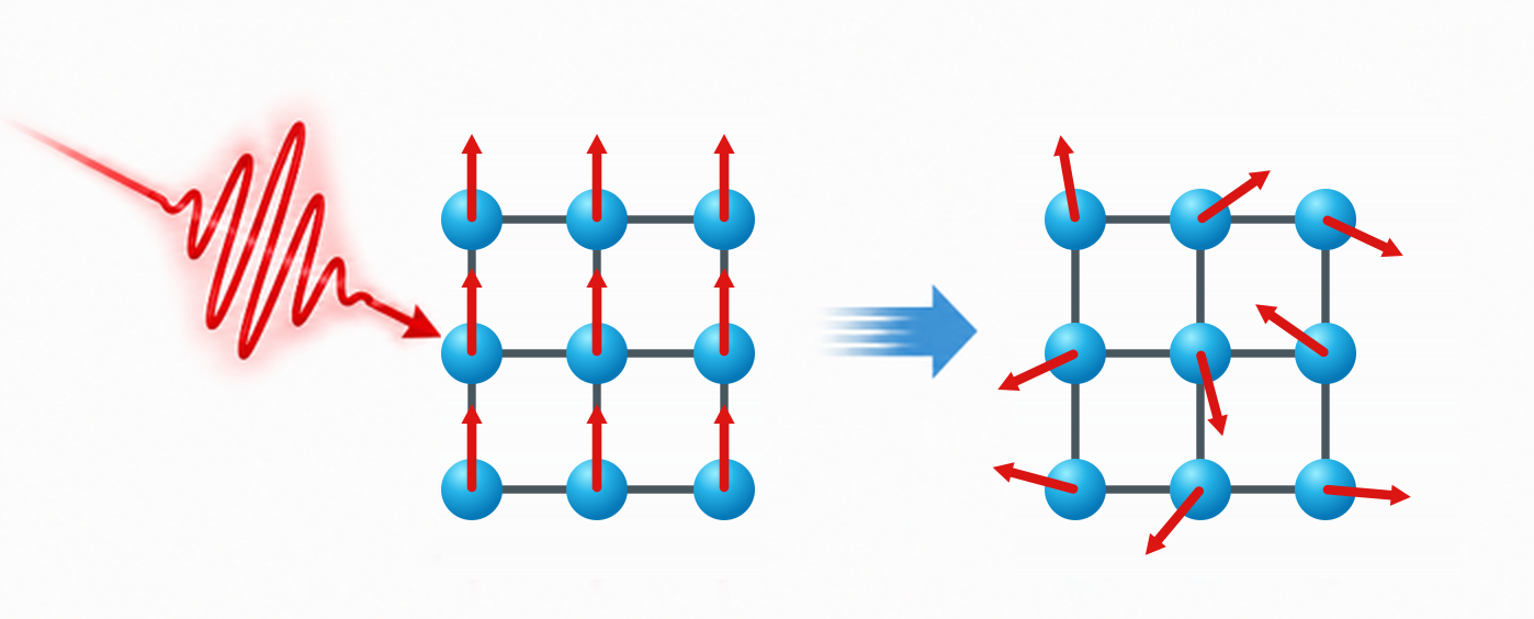
図1:超高速消磁の模式図。磁石に超短パルスレーザーを照射すると、そろっていたスピンの向きが極めて短時間(1兆分の1秒〜1000兆分の1秒)で乱れ、磁化が減少します。青球が原子、赤矢印がスピンを表します。
<関連情報>
- https://www.u-hyogo.ac.jp/news/pressrelease/20261002press.html
- https://www.u-hyogo.ac.jp/20261002press.pdf
- https://pubs.aip.org/aca/sdy/article/13/5/054501/3405452/Bayesian-model-comparison-of-type-I-and-type-II
タイプIおよびタイプII超高速消磁ダイナミクスのベイズモデル比較
Bayesian model comparison of type-I and type-II ultrafast demagnetization dynamics
Hiroki Wadati;Tetsuro Ueno
Structural Dynamics Published:September 28 2026
DOI:https://doi.org/10.1063/4.0001228
Ultrafast demagnetization dynamics are often phenomenologically classified into type-I and type-II responses according to their temporal evolution following femtosecond laser excitation. However, finite experimental temporal resolution and noise can substantially obscure the intrinsic dynamics and complicate this classification. In this work, we investigate the distinguishability of type-I and type-II demagnetization dynamics using Gaussian-convolved phenomenological models and Bayesian information criterion-based statistical model comparison. Synthetic datasets with varying temporal resolution and noise levels were first analyzed to evaluate the conditions under which the two classes can be reliably discriminated. We show that convolution with the instrumental response function significantly reduces the observable differences between the intrinsic responses, thereby producing broad regimes in which model discrimination becomes statistically inconclusive. The applicability of the framework is further demonstrated through analysis of representative experimental ultrafast demagnetization data from NiCo2O4 thin films. These results suggest that the apparent classification of ultrafast demagnetization dynamics can be highly sensitive to experimental resolution, noise level, and analysis methodology.

