2026-02-26 マサチューセッツ工科大学(MIT)
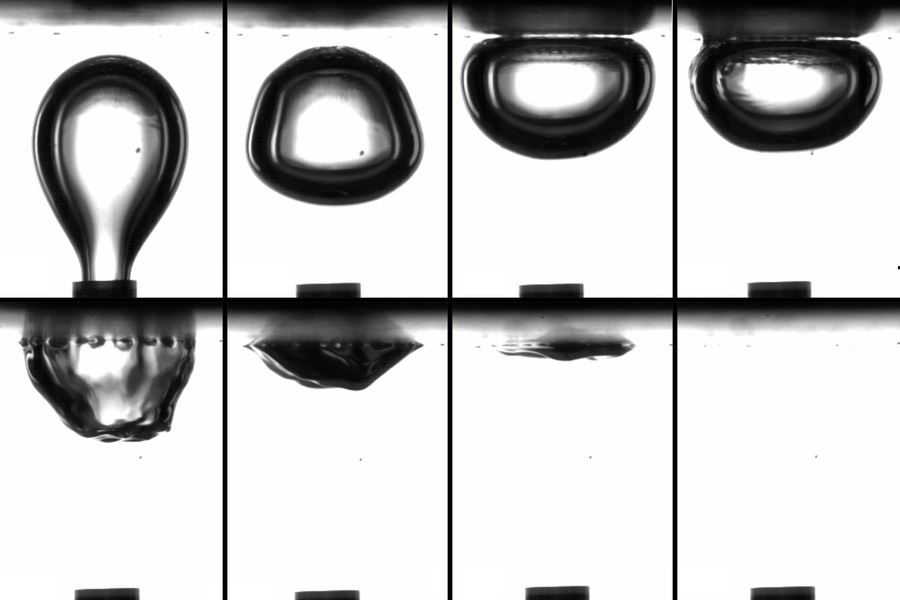
“We have figured out the structure of these bubble-attracting membrane materials to allow gas to evacuate in the fastest possible manner,” says Kripa Varanasi. This collage of video stills shows a bubble hitting the surface membrane (top right) and then destroyed in about 8 milliseconds (bottom row).Credit: Courtesy of the researchers
<関連情報>
- https://news.mit.edu/2026/tackling-industrys-burdensome-bubble-problem-0226
- https://www.pnas.org/doi/10.1073/pnas.2526444123
好気性脱泡 Aerophilic debubbling
Bert J. C. Vandereydt, Saurabh Nath, and Kripa K. Varanasi
Proceedings of the National Academy of Sciences Published:February 23, 2026
DOI:https://doi.org/10.1073/pnas.2526444123
Significance
From soda to reactors, bubbles gather on interfaces and alter system behavior. These bubbles compromise throughput, selectivity, and stability in reactors, separations, and microfluidics, while driving foaming in natural systems. Here, we show how combined porosity and aerophilicity enables rapid bubble evacuation, reducing timescales from tens of seconds to milliseconds. Using high-speed imaging and broad parameter sweeps (seven orders of magnitude in permeability, six in inertia, and four in visco-capillary dissipation), we provide experimental evidence for the mechanism driving evacuation from the bubble scale down to the pore. The resulting phase map and design rules establish a framework for aerophilic debubbling, with applications from CO2 capture to bioreactors.
Abstract
Gas bubbles frequently accumulate at liquid interfaces, compromising throughput, selectivity, and stability across scales from microfluidics to natural ecosystems. Here, we experimentally show that highly permeable aerophilic membranes placed on a liquid–air interface annihilate bubbles within milliseconds. This ultrafast regime appears only above a critical permeability threshold, where the flow departs from classical Darcy-driven dynamics in micropores. We quantitatively characterize this aerophilicity-mediated debubbling process by examining local interactions at the scale of single bubbles approaching the membrane and identify three asymptotic evacuation regimes, the physics of which we capture through simple scaling laws.