
2026-09-15 海洋研究開発機構,九州大学,東京大学,高知大学,北海道大学
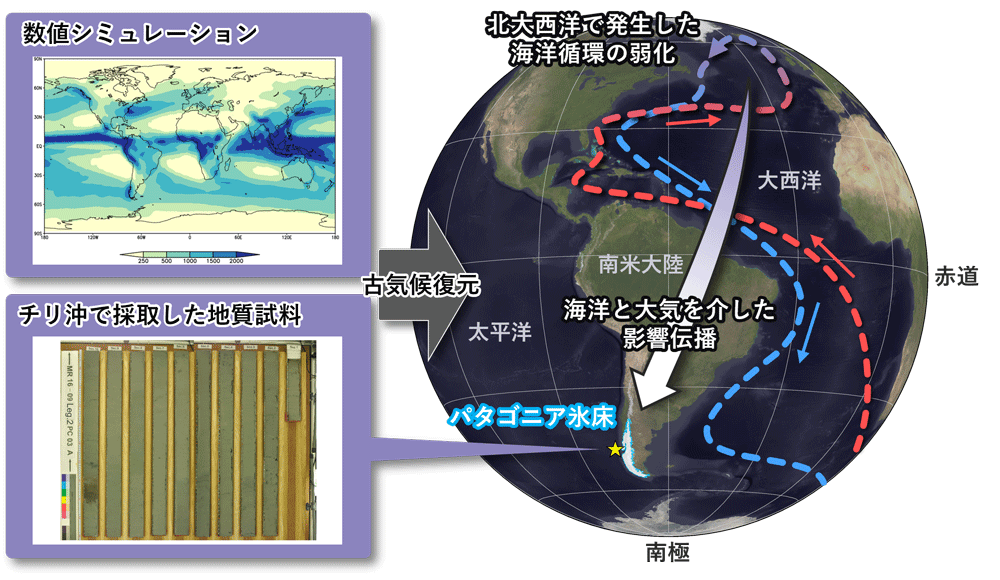
図1 地質試料と数値シミュレーションを用いた過去の地球規模の気候変動連鎖の復元
(衛星写真:https://science.nasa.gov/earth/earth-observatory/the-blue-marble-true-color-global-imagery-at-1km-resolution/)
<関連情報>
- https://www.jamstec.go.jp/j/about/press_release/20260915/
- https://www.pnas.org/doi/10.1073/pnas.2532733123
パタゴニア氷床の流出は、熱的双極シーソーによるAMOCの減速によって促進される Patagonian Ice Sheet discharge enhanced by AMOC slowdown through thermal bipolar seesaw
Takuto Kasuya, Yuta Kuniyoshi, Kana Nagashima, +11 , and Yusuke Okazaki
Proceedings of the National academy of Sciences Published: September 14, 2026
DOI:https://doi.org/10.1073/pnas.2532733123
Abstract
The Atlantic Meridional Overturning Circulation (AMOC) transports heat globally, and its potential weakening would be crucial for future climate projections. Valuable insights into climatic impacts of AMOC slowdowns can be gained from the last glacial period, when millennial-scale AMOC reductions recurrently triggered large-scale reorganizations of the atmosphere-ocean system. However, hydroclimatic responses within the Southern Hemisphere Westerly Wind (SWW) belt—a key region for the global carbon cycle—remain poorly constrained. Here we present a marine sediment record from ~150 km offshore Chile in the eastern South Pacific that documents millennial-scale increases in detrital discharge from the western Patagonian Ice Sheet, temporally associated with AMOC slowdowns. These discharge events likely resulted from ice-sheet expansion and the associated marginal melt linked to gradually enhanced orographic precipitation under SWW and temperature rise. Our simulations with a coupled atmosphere-ocean general circulation model support enhanced precipitation along the Chilean margin south of 45°S and warming-induced melting due to millennial-scale AMOC slowdowns. The precipitation increase reflects the progressive southward intensification of the SWW and the enhanced sea-surface evaporation resulting from Southern Ocean warming through the thermal bipolar seesaw. Together, proxy and modeling results demonstrate that abrupt AMOC slowdowns drove coupled atmospheric-oceanic responses in the South Pacific that promoted Patagonian hydroclimate and ice-sheet changes and may have amplified wind-driven ventilation of the Southern Ocean. These findings highlight the tight coupling between interhemispheric atmospheric and oceanic circulation, cryosphere dynamics, and the global carbon cycle, and raise the possibility of future abrupt shifts in far-field hydroclimate and atmospheric CO2.

