

2026-08-26 名古屋工業大学,産業技術総合研究所
<関連情報>
- https://www.nitech.ac.jp/news/press/2026/14220.html
- https://www.sciencedirect.com/science/article/abs/pii/S1359645426007056
準安定p型TiNiSn–HfNiSn固溶体における熱電性能向上の構造的および電子的起源 Structural and Electronic Origins of Enhanced Thermoelectric Performance in Metastable p-type TiNiSn–HfNiSn Solid Solutions
Takumi Seido, Hidetoshi Miyazaki, Ryusei Inden, Yoichi Nishino, Masashi Mikami
Acta Materialia Available online: 28 July 2026
DOI:https://doi.org/10.1016/j.actamat.2026.122605
Highlights
- Homogeneous TiNiSn–HfNiSn solid solutions formed via sintering/PECS processes.
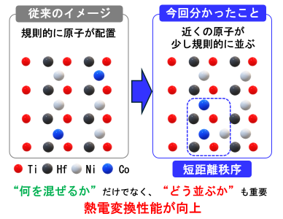
- Short-range order thermodynamically stabilizes metastable solid solutions.
- Microscopic lattice strain and alloy disorder govern electrical resistivity.
- HAXPES and simulated-DOS spectra reveal defect-mediated Fermi level shift, not rigid-band modulation.
- Hf-induced suppression of Ni interstitial donors pulls Fermi level onto steep valence-band edge.
Abstract
The Development of high-performance p-type half-Heusler alloys is crucial for thermoelectric power generation. Although a miscibility gap exists in the TiNiSn–HfNiSn system, recent studies report excellent thermoelectric performance. To clarify the microscopic origin of this enhancement, we investigated the crystal and electronic structures of p-type Ti1–xHfxNi0.8Co0.2Sn solid solutions using synchrotron X-ray diffraction (XRD), hard X-ray photoelectron spectroscopy (HAXPES), and density functional theory (DFT). XRD revealed a homogeneous single-phase C1b structure across the entire composition range. This metastable stabilization originates kinetically from rapid densification via pulsed electric current sintering and thermodynamically from the spontaneous formation of short-range order (SRO), which minimizes internal elastic strain. Additionally, lattice strain—dominated by alloy disorder—strongly correlated with electrical resistivity. Furthermore, HAXPES measurements showed a systematic shift of the valence band edge and core levels toward lower binding energies with increasing Hf content. Direct comparison with DFT-simulated spectra demonstrates that this shift is not caused by intrinsic band modulation is not an intrinsic band modulation. Instead, it is governed by a defect-mediated downward shift of the macroscopic Fermi level. Specifically, Hf substitution suppresses electron-donating Ni interstitials, removing carrier compensation and allowing Co-induced holes to pull the Fermi level onto the steep valence-band slope. This study provides comprehensive evidence that the enhanced p-type thermoelectric performance in metastable solid solutions arises from a synergy of SRO-driven phonon scattering and defect-mediated Fermi-level tuning.