2026-09-14 カリフォルニア大学リバーサイド校(UCR)
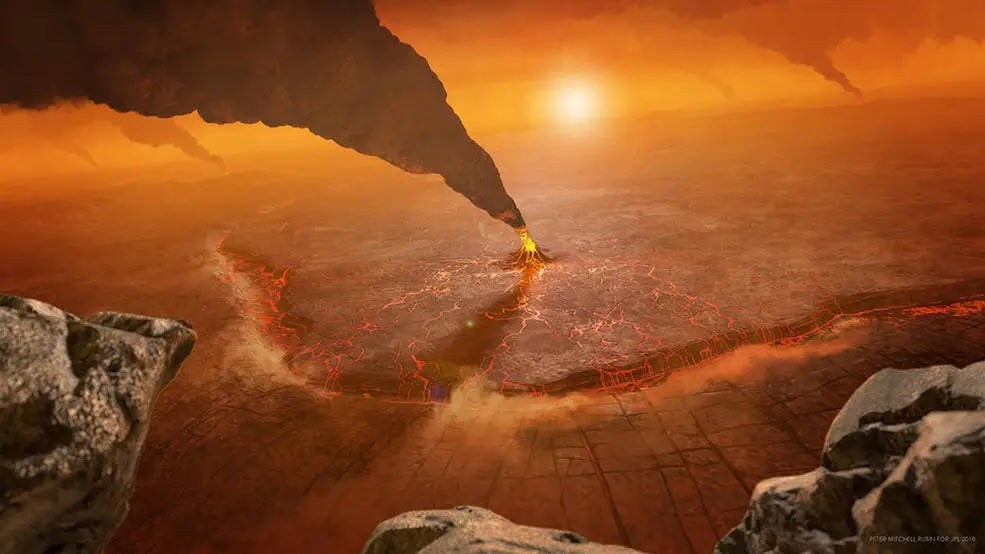
Illustration depicts active volcanism in Venus’ southern hemisphere. (NASA/JPL-Caltech/Peter Rubin)
<関連情報>
- https://news.ucr.edu/articles/2026/09/14/venus-ate-its-moon
- https://iopscience.iop.org/article/10.3847/1538-4357/ae9d6c
潮汐による終焉:架空の金星衛星の進化と運命 Tidal Demise: The Evolution and Fate of a Hypothetical Venus Moon
Stephen R. Kane, Franck Selsis, Jérémy Leconte, and Sean N. Raymond
The Astrophysical Journal Published: 2026 September 14
DOI:10.3847/1538-4357/ae9d6c
Abstract
Venus possesses no natural satellite, raising the question of whether a formed moon could have survived. We explore the tidal evolution of a Venus-moon system, coupling Venus’s spin to the satellite’s orbit under tides from the moon and Sun. We survey spin period (P0 = 5–100 hr), moon mass (Mm = 0.01–10 MMoon), eccentricity, quality factor, and initial semimajor axis under both constant-Q and constant time lag models. Survival depends on competition between outward migration (∝Mm) and synchronous radius expansion (∝M2m): for circular orbits around a rapidly spinning Venus (P0 ≲ 12 hr), a lunar-mass satellite survives the age of the solar system in both models. For P0 ≲ 10 hr, eccentricity pumping can destabilize low-mass satellites, while for P0 ≳ 15 hr or Mm ≳ 2 MMoon, the synchronous radius overtakes the orbit and drives Roche destruction within ∼0.03–1.7 Gyr in the constant-Q model. The constant time lag model instead permits quasi-synchronous survival for massive moons at fast spin. Explaining Venus’s present state requires satisfying two constraints simultaneously: loss of the satellite and despinning of an initially rapid rotator. Both are met only within a restricted region of parameter space, favoring moderate postimpact spin periods and lunar-to-super-lunar masses. Giant impact simulations predict spin periods ≳12 hr for Venus’s present rotation, placing a lunar-mass satellite at the survival boundary. For last-impact conditions within this region, the present absence of a Venusian satellite arises through tidal evolution alone; a subsequent catastrophic stripping event, while capable of removing a moon, is not required.