2026-08-07 中国科学院(CAS)
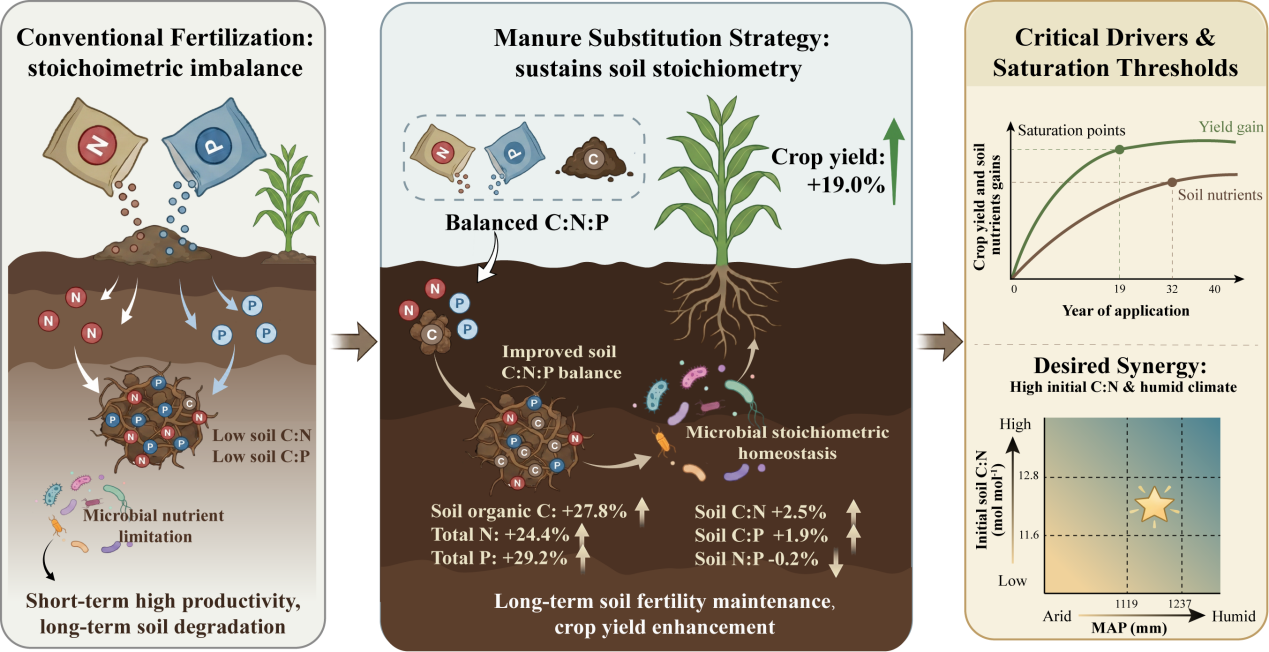
Manure substitution for chemical fertilizers improves soil nutrient balance and enhances crop yield. (Image by ZHENG Li, et al)
<関連情報>
- https://english.cas.cn/newsroom/research-news/202608/t20260810_1186976.shtml
- https://www.sciencedirect.com/science/article/pii/S0167198726003181?via%3Dihub
堆肥の代替は土壌の化学量論を維持し、世界的な作物収量を向上させる Manure substitution sustains soil stoichiometry and enhances global crop yields
Li Zheng, Josep Penuelas, Jordi Sardans, Fernando Coello, Yanyan Li, Jiacong Zhou, Yixuan Zhang, Yong Hu, Jinzhao Liu, Zimin Li, Yuexi Jiang, Ji Liu
Soil and Tillage Research Available online: 14 July 2026
DOI:https://doi.org/10.1016/j.still.2026.107373
Highlights
- Manure substitution boosts soil organic C (27.8%), total N (24.4%), and P (29.2%).
- Manure substitution significantly enhances crop yield by an average of 19.0%.
- Soil nutrients accumulate for ∼30 years, whereas crop yield gains plateau after ∼20 years.
- Manure works best in humid climates with high initial soil C:N ratios (11.6–12.8).
Abstract
Substituting mineral fertilizers with livestock manure represents a pivotal strategy for achieving sustainable agriculture by improving soil fertility and resource efficiency. However, a systematic global assessment of its long-term effects on soil carbon (C), nitrogen (N), and phosphorus (P) balance, and the subsequent impacts on crop productivity are lacking. Here, we synthesize 710 paired field observations from 179 sites across diverse climatic zones to evaluate how manure substitution influences soil and microbial nutrient pools, ecological stoichiometry, and crop yield relative to synthetic fertilizer alone. Our analysis shows that manure application significantly increases soil organic C (27.8%), total N (24.4%), and total P (29.2%), elevates soil C:N ratio (2.5%), and enhances crop yield (19.0%). These effects are modulated by application duration, initial soil C:N ratio, and mean annual precipitation. We identify distinct temporal thresholds: yield improvements plateau after approximately 20 years, whereas soil nutrient accrual continues for about 30 years before reaching saturation. Manure substitution proves highly effective in achieving synergistic gains in soil nutrients and crop yields, particularly in soils with higher initial C:N ratio (11.6–12.8) under humid climates (MAP, 1119–1237 mm). Our findings demonstrate that manure substitution can simultaneously boost soil nutrients and crop yields by maintaining balanced stoichiometry, enhancing C sequestration, and reducing dependence on mineral fertilizers. Tailoring manure application strategies to local soil fertility and precipitation patterns offers a scalable pathway to advance both food security and environmental sustainability.