2026-08-05 大阪大学,東京大学,東京都立大学
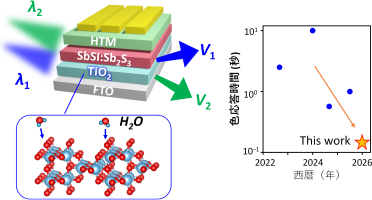
図1:本研究で開発した光検出素子の概要と材料構造
<関連情報>
- https://www.issp.u-tokyo.ac.jp/maincontents/news2.html?pid=31805
- https://advanced.onlinelibrary.wiley.com/doi/10.1002/adfm.76809
吸水誘起型カラーセンサー:センシングメカニズムの解明と応答性向上のための界面エンジニアリング Water Adsorption-Induced Color Sensor: Insight Into the Sensing Mechanism and Interfacial Engineering for Improved Responsiveness
Tai Kobayashi, Ryosuke Nishikubo, Yusuke Tomiyori, Fumitaka Ishiwari, Daisuke Asakura, Eiji Hosono, Miho Kitamura, Hisao Kiuchi, Yoshihisa Harada, Akinori Saeki
Advanced Functional Materials Published: 23 July 2026
DOI:https://doi.org/10.1002/adfm.76809
ABSTRACT
Color-sensitive photodetectors are at the forefront of next-generation light- and image-sensing research. In this context, a photovoltaic device employing SbSI:Sb2S3 and TiO2 as the visible light absorber and electron transport material, respectively, exhibits a unique wavelength-dependent photovoltage effect and its reversible output in response to changing humidity levels. However, the specific functions of the individual layers of the device and their interaction with water remain largely unknown. In this study, we perform in situ X-ray absorption spectroscopy (XAS) of thin films under humidity-controlled conditions to reveal the interaction between water and the photovoltaic layers. The oxygen K-edge XAS data reveal the adsorption of water molecules onto TiO2. Ultraviolet (UV) irradiation of TiO2 can trigger photochemical reactions of the adsorbed water at the interface, which is considered to contribute to changes in the photovoltage. Based on this finding, we introduce hydrophilic layers between TiO2 and SbSI:Sb2S3 to promote the accumulation of water in the devices, which successfully enhance both the wavelength sensitivity and response speed. Finally, we demonstrate color recognition with various irradiation intensities, thereby broadening the scope and applications of unique wavelength-responsive single-cell photovoltaics.