2026-08-04 東北大学
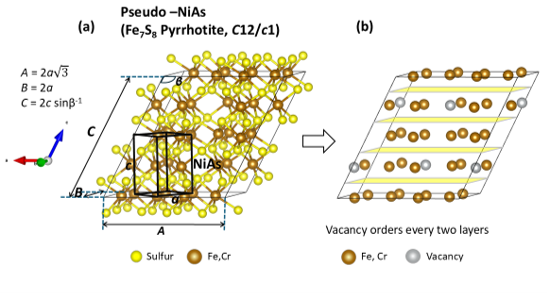
図1(a). ピロータイト型結晶構造。六方晶NiAs型構造をa軸とc軸に2個ずつ積み上げたような構造である。(b) Fe (Cr)の層に着目すると、1層おきに空孔が規則的に配列している。高温からの急冷でその空孔の配置が不規則化し、磁化補償温度が制御可能であることが本研究で明らかになった。
<関連情報>
- https://www.tohoku.ac.jp/japanese/2026/08/press20260804-06-spintronics.html
- https://onlinelibrary.wiley.com/doi/10.1002/smll.74603
磁硫鉄鉱型構造を有する(Cr,Fe)S化合物の完全補償型フェリ磁性特性 Fully Compensated Ferrimagnetic Properties of (Cr,Fe)S Compound with a Pyrrhotite-Type Structure
Weida Yin, Masato Miyakawa, Satoshi Semboshi, Noriharu Yodoshi, Akira Masago, Yosuke Kawahito, Tetsuya Fukushima, Hisazumi Akai, Rie Y. Umetsu
Small Published: 03 August 2026
DOI:https://doi.org/10.1002/smll.74603
ABSTRACT
To optimize the processing conditions for the (Cr,Fe)S non-equilibrium phase with a pyrrhotite-type structure, the phase states and magnetic properties of the specimens obtained at various sintering temperatures were investigated. A slightly off-stoichiometric composition of Cr23Fe23S54 (approximately (Cr,Fe)7S8) sintered and quenched from 1323 K indicates a single-phase pyrrhotite-type structure with a layered-NiAs-type structure in which vacancies occupy every two layers (C12/c1; the space number is 15). The compound shows fully compensated ferrimagnetic behavior at a magnetization compensated temperature of approximately 200 K. The magnetic behavior exhibits a typical N-type ferrimagnet, as predicted by Néel. From X-ray photoelectron spectroscopy analyses, it is found that the compound is composed of Fe2+ and Cr3+. The large magnetic coercivity of 38 kOe at 5 K is also unique and can be applied to spintronic devices. Furthermore, changing the quenching temperature enables control of the degree of order of the vacancies in the interlayer and results in tuning of the magnetization compensated temperature. First-principles calculations show a pseudo-gap located at the Fermi level in the up-spin band, suggesting high spin polarization as well as the NiAs-type structure indicated in our previous report.