2026-08-05 東北大学
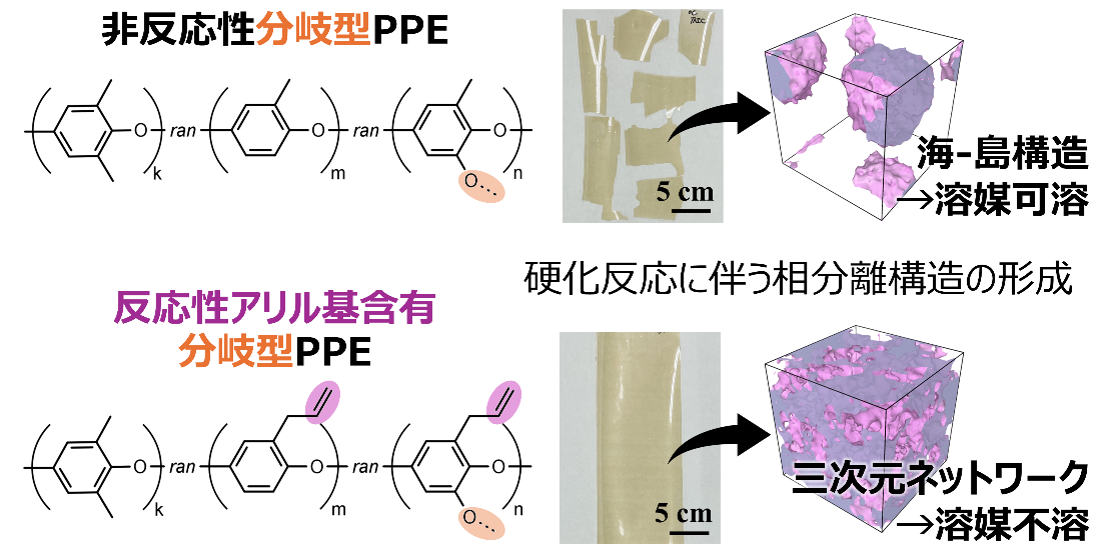
図1 反応性PPEによる三次元ネットワーク形成と耐溶剤性向上のメカニズム
<関連情報>
- https://www.tohoku.ac.jp/japanese/2026/08/press20260805-02-dpds.html
- https://pubs.rsc.org/py/article/doi/10.1039/d6py00585c/1284136/Synthesis-of-allyl-functionalized-branched-poly
ネットワーク形成と耐溶剤性を可能にするアリル官能化分岐ポリ(フェニレンエーテル)の合成:実験的および硬化散逸粒子動力学研究
Synthesis of allyl-functionalized branched poly(phenylene ether) enabling network formation and solvent resistance: an experimental and curing dissipative particle dynamics study
Shoko Mishima;Yoshiaki Kawagoe;Kaho Shibasaki;Nobuhiro Ishikawa;Tomonaga Okabe
Polymer Chemistry Published:22 July 2026
DOI:https://doi.org/10.1039/d6py00585c
Reactive poly(phenylene ether)s (PPEs) prepared under branching conditions and bearing allyl functionalities were rationally designed and synthesized via copper-catalyzed oxidative copolymerization to simultaneously achieve pre-curing solubility and post-curing solvent resistance. By employing 2-allylphenol as a comonomer possessing both a reactive allyl group and the ability to introduce structural heterogeneity through ortho-position polymerization, an allyl-functionalized PPE (B-aPPE) was successfully prepared. The introduction of allyl groups enabled covalent incorporation of PPE chains into thermoset networks upon curing with triallyl isocyanurate (TAIC). Compared with the corresponding non-reactive PPE prepared under branching conditions (B-PPE), the synthesized B-aPPE exhibited markedly improved film integrity and significantly reduced weight loss after chloroform immersion. To elucidate the structure–property relationship arising from this molecular design, curing dissipative particle dynamics (DPD) simulations were performed. The simulations provided qualitative mechanistic insight, suggesting that reactive allyl sites suppress TAIC aggregation and promote formation of a percolated three-dimensional network, leading to enhanced solvent resistance. This study demonstrates that introduction of reactive allyl functionality into PPEs prepared under branching conditions provides an effective strategy for tuning reaction-induced phase separation (RIPS) and developing solvent-resistant thermosetting polymer systems.