2026-10-20 合肥物質科学研究院(HFIPS)
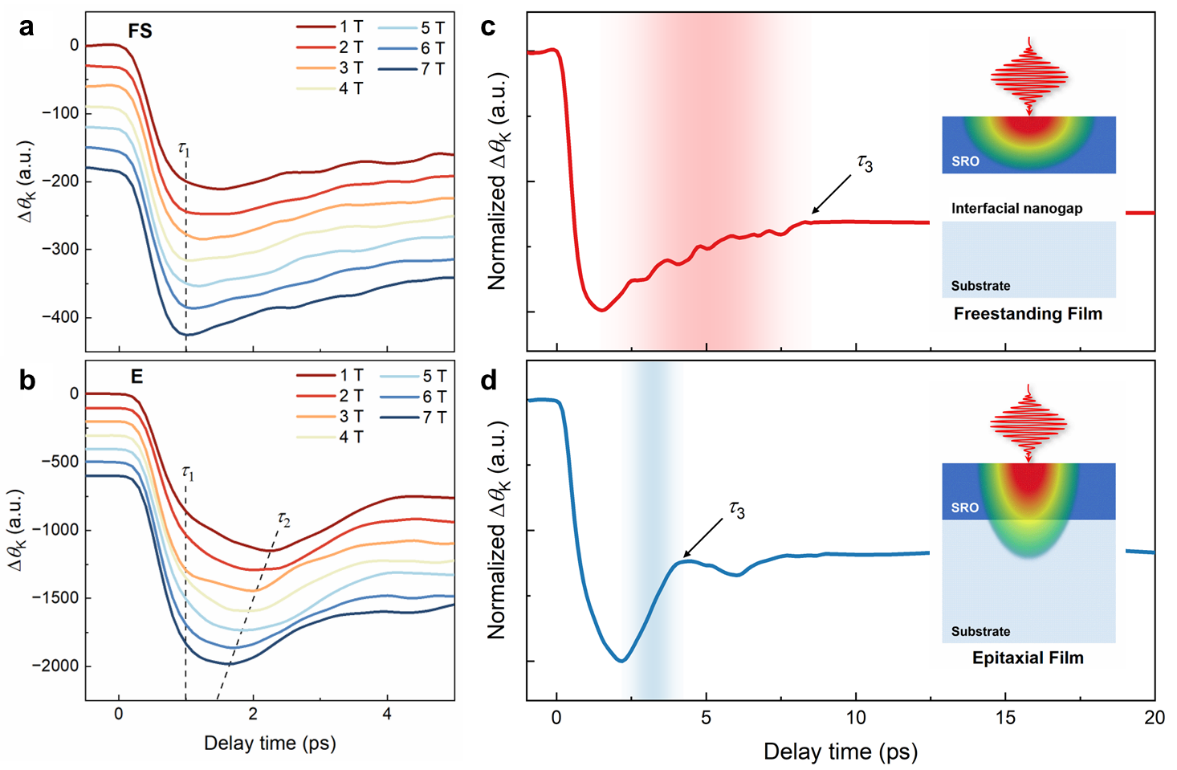
Ultrafast magnetization dynamics and interfacial schematics of freestanding and epitaxial SrRuO3 films. (Image by LU Qinwen)
<関連情報>
- https://english.hf.cas.cn/nr/rn/202610/t20261020_1208833.html
- https://onlinelibrary.wiley.com/doi/10.1002/smll.74613
歪み制御された超高速スピンダイナミクスにより、フレキシブルスピントロニクス向けSrRuO₃膜における磁化と熱輸送の分離が明らかに Strain-Engineered Ultrafast Spin Dynamics Revealing Decoupled Magnetization and Heat Transport in SrRuO3 Membranes for Flexible Spintronics
Qinwen Lu, Bo Hao, Yifan Ren, Zhou Wang, Biwen Huang, Yuefeng Nie, Zhigao Sheng
Small Published: 15 July 2026
DOI:https://doi.org/10.1002/smll.74613
ABSTRACT
Releasing complex oxides from rigid substrates eliminates clamping effects and enables strain engineering, yet the impact of this freestanding architecture on ultrafast spin dynamics remains elusive. We report that strain relaxation in freestanding SrRuO3 membranes reduces saturation magnetization to 0.73 µB/Ru while enhancing the Curie temperature to 160 K. Time-resolved magneto-optical Kerr effect spectroscopy reveals distinct single-step demagnetization kinetics (∼1 ps) in membranes, contrasting with the slower two-step process in epitaxial films. Microscopic three-temperature model simulations attribute this to reduced magnetization, which requires fewer spin-flip scattering events and doubles the demagnetization rate factor. Additionally, we demonstrate that the underlying interfacial nanogap acts as a near-ideal thermal barrier, significantly delaying the slow remagnetization process. These findings elucidate the interplay between lattice strain and spin relaxation, identifying freestanding membranes as a promising platform for decoupling magnetic and thermal transport in energy-efficient flexible spintronics.