2026-07-16 ノースウェスタン大学
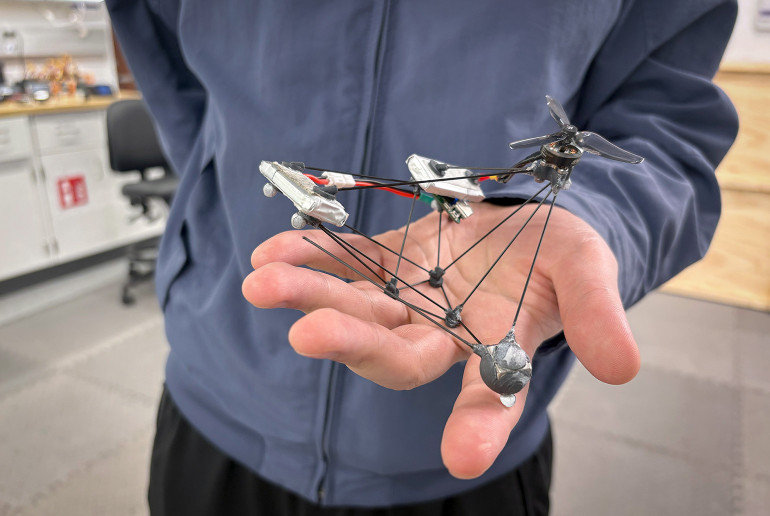
To design the drone, the Northwestern team, led by Michael Rubenstein, first used a computational model to generate roughly 20,000 drone configurations capable of stable flight. Then, they used AI and optimization algorithms to repeatedly rearrange the drones’ major components, including a motor, propeller, circuit board, counterweight and batteries.← Show Less Caption
<関連情報>
- https://news.northwestern.edu/stories/2026/07/new-spinning-drone-hides-in-plain-sight
- https://www.roboticsproceedings.org/rss22/p196.pdf
人間と調和した知覚指標を用いた低視認性無人航空機の計算機設計 Computational Design of a Low-Visibility UAV Using a Human-Aligned Perceptual Metric
Jingxian Wang, Chen Yu, David Matthews, Emma Alexander, Sam Kriegman, Michael Rubenstein
Robotics: Science and Systems 2026 Robot & Sensor Design
Abstract
We introduce Phantom Twist, a type of single-propeller UAV designed to achieve low visibility through high-speed spinning and the exploitation of motion blur. We develop a two-stage automated design pipeline that optimizes the placement of functional components including batteries, control PCB, motor-propeller assembly, and counterweights. The pipeline minimizes visibility as measured by a human-aligned perceptual metric (LPIPS) while strictly satisfying inertial and aerodynamic constraints required for stable flight. We validate this approach through fabrication and flight testing of multiple prototypes. These tests confirm that our pipeline produces stable, controllable designs and that the optimized UAV exhibits significantly reduced visual perceptibility compared to conventional quadcopters.