2026-08-05 関西学院大学
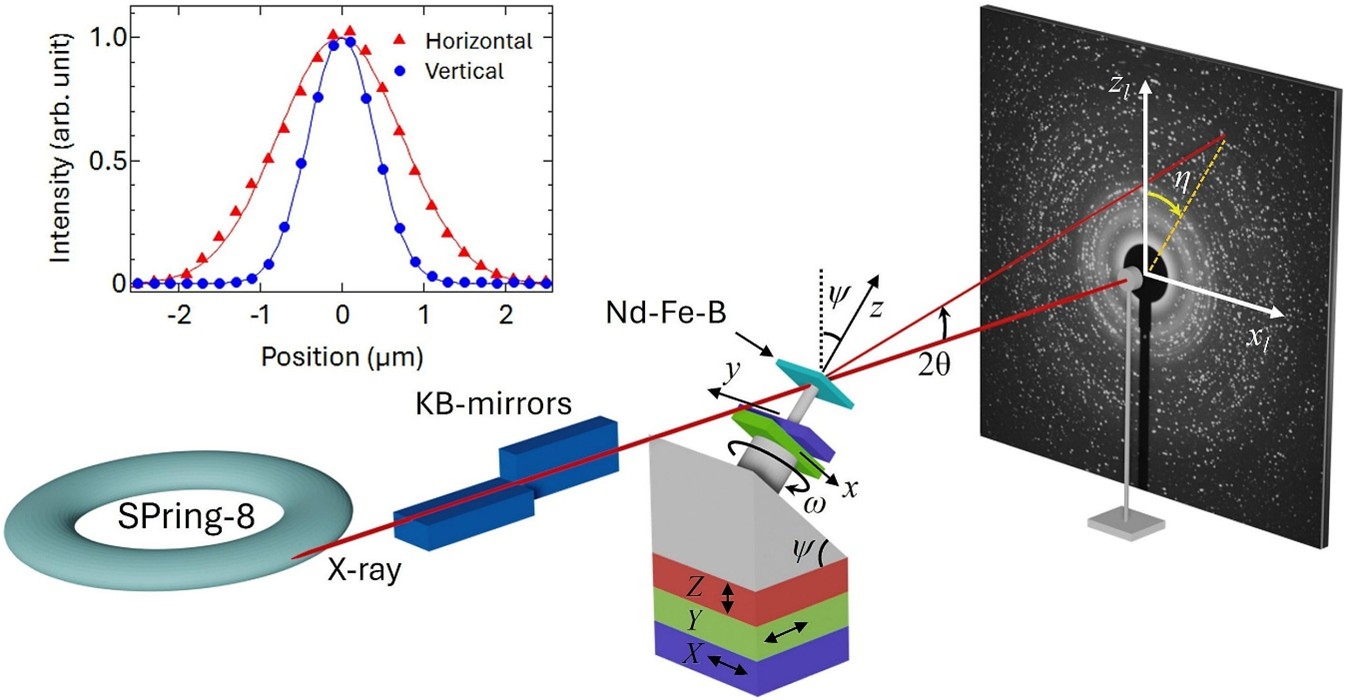
図1:大型放射光施設SPring-8で行った、永久磁石材料の3次元X線回折イメージング実験の概略図
<関連情報>
- https://www.kwansei.ac.jp/news/06600.html
- https://www.sciencedirect.com/science/article/pii/S0264127526012463
Nd–Fe–B永久磁石の非破壊三次元方位マッピング Non-destructive three-dimensional orientation mapping of Nd–Fe–B permanent magnets
Jaemyung Kim, Yujiro Hayashi, Tomomi Suwa, Akiyama Yusuke, Takuya Taniguchi, Kousuke Katou, Kaiki Takemura, Satoshi Okamoto, Motohiro Suzuki, Makina Yabashi
Materials & Design Available online: 25 July 2026
DOI:https://doi.org/10.1016/j.matdes.2026.116671
Highlights
- i-S3DXRD enables nondestructive 3D visualization of grains in Nd–Fe–B magnets.
- Surface orientations agree well with EBSD, validating the 3D orientation map.
- The internal grain map reveals a strong easy-axis fiber texture.
Abstract
Three-dimensional observation of individual grains is essential for a comprehensive understanding of the magnetic properties of Nd–Fe–B permanent magnets. Local features such as grain size, shape, and crystallographic orientation must be resolved, as bulk-averaged measurements cannot adequately explain magnetic behavior. Although three-dimensional electron backscatter diffraction can provide such information, its application to Nd–Fe–B magnets is challenging due to surface damage during serial sectioning. Therefore, a nondestructive approach to three-dimensional orientation mapping is required. In this study, we apply the recently developed inclined scanning three-dimensional X-ray diffraction microscopy (i-S3DXRD) to obtain a nondestructive three-dimensional orientation map of a neodymium magnet. The results reveal a pronounced three-dimensional fiber texture, in which the c-axis—the magnetic easy axis—is preferentially aligned parallel to the specimen x-axis, while the a-axis is randomly distributed. Surface orientation maps show good agreement with EBSD results. Orientation distribution function analysis revealed a fiber-type texture with a substantial mosaicity. Analysis of the volumetric orientation map further shows that the triple-junction network exhibits a complex three-dimensional distribution throughout the volume, with junction segment lengths comparable to the grain size. These results demonstrate that i-S3DXRD is a powerful nondestructive technique for comprehensive characterization of permanent magnets.