2026-07-06 合肥物質科学研究院(HFIPS)
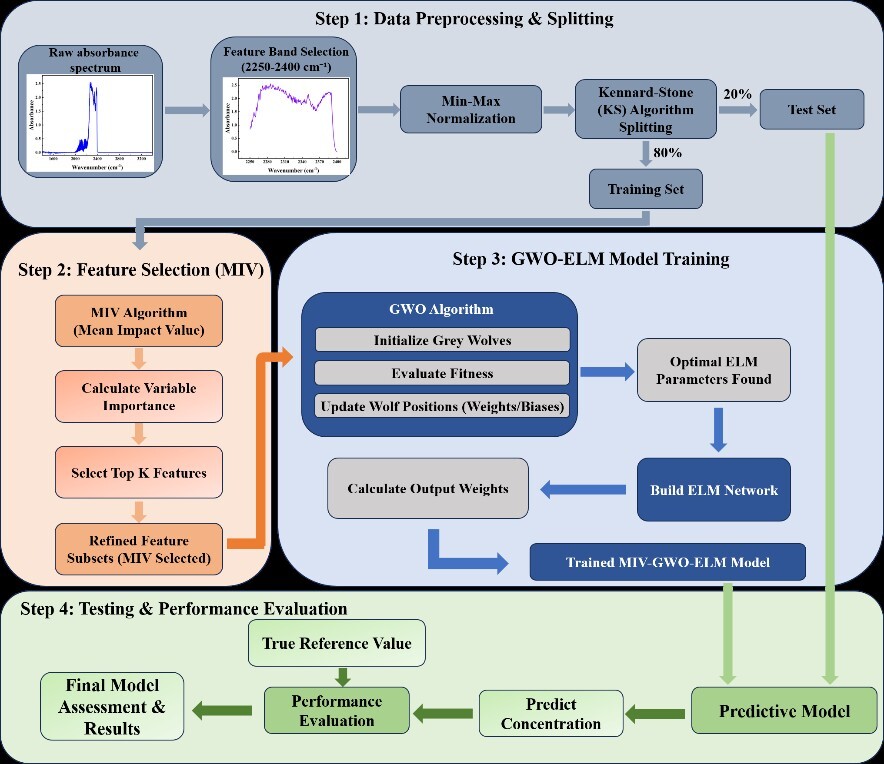
Operational mechanism of the mean impact value-enhanced gray wolf optimizer-based extreme learning machine (MIV-GWO-ELM) hybrid prediction model. (Image by LI Xiangxian)
<関連情報>
- https://english.hf.cas.cn/nr/bth/202607/t20260706_1176334.html
- https://pubs.acs.org/doi/10.1021/acs.analchem.6c00399
- https://www.sciencedirect.com/science/article/abs/pii/S1350449526002380
高濃度CO₂のFTIR定量分析: MIV-GWO-ELM統合フレームワークによる飽和効果の克服 FTIR Quantitative Analysis of High-Concentration CO2: Overcoming Saturation Effects via an MIV-GWO-ELM Integration Framework
Tianxiang Zhao,Cunguang Zhu,Pengpeng Wang,Zhanshang Su,Xin Han,Yusheng Qin,Renjie Fang,Kaixiang Fan,and Xiangxian Li
Analytical Chemistry Published :May 30, 2026
DOI:https://doi.org/10.1021/acs.analchem.6c00399
Abstract
The quantitative analysis of Fourier transform infrared (FTIR) spectroscopy for monitoring high-concentration industrial gases, such as CO2 in steel manufacturing, is severely challenged by spectral absorption saturation, which introduce strong nonlinearities and degrade the accuracy of traditional methods. To address this, we propose a hybrid inversion framework, the mean impact value-enhanced gray wolf optimizer-based extreme learning machine (MIV-GWO-ELM), which synergizes intelligent spectral feature selection via MIV to mitigate saturation effects and employs GWO for the global optimization of ELM’s initial parameters to enhance stability. Experimental results on high-concentration CO2 (5.0%–9.75%) demonstrate the model’s performance, reducing MAE, RMSE, and MAPE by 79.72%, 79.50%, and 78.58%, respectively, compared to the baseline ELM, while also outperforming the Levenberg–Marquardt algorithm and a multilayer perceptron with approximate error reductions of 71% and 58%, all within a training time of under 13 s. This work effectively enhances the precision of FTIR systems under nonlinear conditions, offering a reliable and efficient solution for industrial gas monitoring and a promising strategy for complex spectroscopic inversions.
FTIR分光法における非線形性の克服:鋼焼結排ガス中の一酸化炭素を高精度にモニタリングするためのハイブリッドPSO-ELMアプローチ Overcoming nonlinearity in FTIR spectroscopy: A hybrid PSO-ELM approach for robust carbon monoxide monitoring in steel sintering flue gas
Tianxiang Zhao, Xiangxian Li, Pengpeng Wang, Xin Han, Yusheng Qin, Renjie Fang, Yujie Duan, Zhanshang Su, Kaixiang Fan, Cunguang Zhu
Infrared Physics & Technology Available online: 24 April 2026
DOI:https://doi.org/10.1016/j.infrared.2026.106603
Highlights
- A hybrid PSO-ELM framework is proposed for CO concentration retrieval in steel sintering flue gas using FTIR spectroscopy.
- Particle Swarm Optimization deterministically optimizes Extreme Learning Machine’s input weights and hidden biases, solving instability from random initialization.
- PSO-ELM reduces MAE and RMSE by 42.76% and 33.77% over standard ELM in industrial tests.
- The method achieves an R² of 0.9997 in 13.08 s, balancing accuracy and efficiency for industrial online monitoring.
Abstract
In the industrial monitoring of sintering emissions, Fourier Transform Infrared (FTIR) spectroscopy faces challenges from nonlinear absorbance-concentration relationships. These nonlinearities primarily stem from instrumental resolution limits and inter-gas cross-interference. To address these issues, this study developed a synergistic PSO-ELM framework for enhanced carbon monoxide (CO) quantification. This approach integrates Particle Swarm Optimization (PSO) to refine the hidden layer parameters of the Extreme Learning Machine (ELM), effectively resolving the stochastic instability inherent in standard ELM models. For experimental validation, the spectral range of 2050–2145 cm⁻1 was selected to target the P-branch of the CO fundamental vibration–rotation band. This selection suppressed overlapping spectral signatures from H2O and CO2. In-situ testing demonstrated that the PSO-ELM model significantly improved predictive accuracy. Compared to the standard ELM, the proposed model reduced the Mean Absolute Error (MAE) and Root Mean Square Error (RMSE) by 42.76% and 33.77%, respectively. Furthermore, the PSO-ELM outperformed Levenberg-Marquardt (LM) and Backpropagation Neural Network (BP-NN) algorithms, achieving an MAE reduction exceeding 45%. The entire prediction process was completed within 14 s, satisfying real-time industrial requirements and providing a robust solution for complex nonlinear gas analysis.