2026-07-06 東北大学
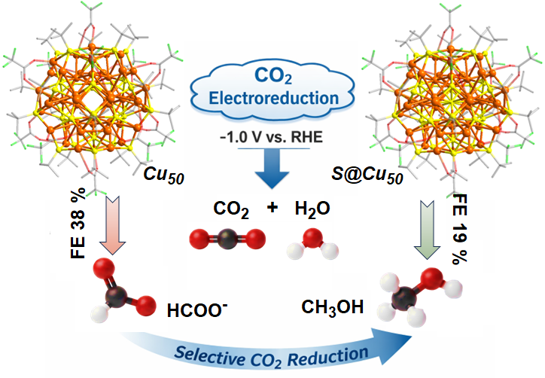
図1. 銅ナノクラスターの構造とCO₂電解還元特性の概要。従来のCu50ナノクラスターでは主にギ酸(HCOO⁻)が生成されるのに対し、硫化物イオンを内包したS@Cu50ナノクラスターではメタノール(CH₃OH)生成が促進される。水素原子は見やすさのため省略した。
<関連情報>
- https://www.tohoku.ac.jp/japanese/2026/07/press20260706-01-co2.html
- https://pubs.acs.org/doi/10.1021/jacsau.6c00817
原子レベルの価数状態エンジニアリングにより、銅ナノクラスター上でのCO2電気還元反応の方向転換が可能になる Atomic-Level Valence-State Engineering Redirects CO2 Electroreduction on Cu Nanoclusters
Qilin Li,Mandira Ghosh,Mohd Rashid,Rupa Sarma,Pradip Kumar Mondal,Tokuhisa Kawawaki,Sourav Biswas,Biswarup Pathak,and Yuichi Negishi
JACS Au Published: June 30, 2026
DOI:https://doi.org/10.1021/jacsau.6c00817
Abstract
Atomically precise thiolate-protected Cu nanoclusters (NCs) typically suffer from an intrinsic bias toward the two-electron formate pathway in CO2 electroreduction, limiting access to more deeply reduced products. Breaking this selectivity within a structurally well-defined system remains a significant challenge due to the difficulty of precisely tuning the Cu valence states. Here, we address this limitation through atomic-level valence-state engineering by introducing [S@Cu50S12(StBu)20(CF3COO)12] (S@Cu50) NC, featuring a controlled Cu(I)/Cu(II) ratio within a conserved structural framework. Single-crystal analysis reveals a core–shell S@Cu14S12@Cu36 architecture, while XPS confirms an increased Cu(II) population compared to the reference [Cu50S12(StBu)20(CF3COO)12] (Cu50) analogue. Despite similar overall catalytic activity, S@Cu50 exhibits a striking shift in product selectivity during CO2 electroreduction, suppressing formate formation (Faradaic efficiency of <11% vs 38% in Cu50) and enabling CH3OH production with a Faradaic efficiency of ∼19% at –1.0 V vs RHE─absent in the Cu50 system. Density functional theory calculations attribute this mechanistic switching to valence-induced electronic modulation, which stabilizes CO-derived intermediates and promotes sequential hydrogenation toward CH3OH, in contrast to HCOO stabilization in the reference NC. This work establishes that subtle modulation of the Cu(I)/Cu(II) balance can fundamentally redirect reaction pathways, providing a molecular-level strategy to overcome intrinsic selectivity limitations in Cu NC catalysis.