2026-07-03 愛媛大学
<関連情報>
- https://www.ehime-u.ac.jp/data_relese/pr_20260703_grc-2/
- https://www.nature.com/articles/s41467-026-71701-8
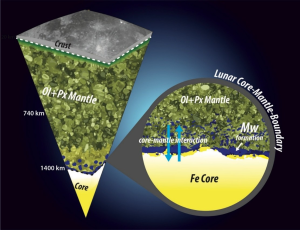
月の核-マントル境界におけるマグネシオウスタイトの反応形成 Reactive formation of magnesiowüstite at the lunar core-mantle boundary
Qianzhi Xu,Shuchang Gao,Wim van Westrenen,Steeve Gréaux,Yoshio Kono,Peiyan Wu,Yongjiang Xu,Sheng Shang,Hua Xiang,Sho Kakizawa,Noriyoshi Tsujino,Yuji Higo & Yanhao Lin
Nature Communications Published:23 April 2026
DOI:https://doi.org/10.1038/s41467-026-71701-8
Abstract
Seismological and geodetic data indicate that the lunar core-mantle boundary (CMB) exhibits a well-defined low-velocity zone (LVZ) with a combination of anomalous seismic velocities and density that remain unexplained. Here, in-house high-pressure experiments simulating the interaction between mantle olivine and core iron at CMB conditions in conjunction with thermodynamic modeling demonstrate reactive formation of dense iron-rich magnesiowüstite [Mw, (Fe,Mg)O], a hitherto unrecognized lunar mineral. In-situ synchrotron ultrasonic measurements show that the seismic velocities and density of Mw, when incorporated in realistic proportions of ~5–15 wt% with mantle olivine plus minor silicate melt match the observed LVZ properties. Oxygen exsolution from core metal during cooling is the most likely driver of Mw formation, quantitatively yielding the required Mw proportions in the LVZ. These results suggest that core-mantle reactions can generate magnesiowüstite through oxidation of iron metal, offering a blueprint for the expected seismic properties of the CMB regions of rocky bodies that experience mantle oxidation after core formation.