2026-07-03 東京科学大学
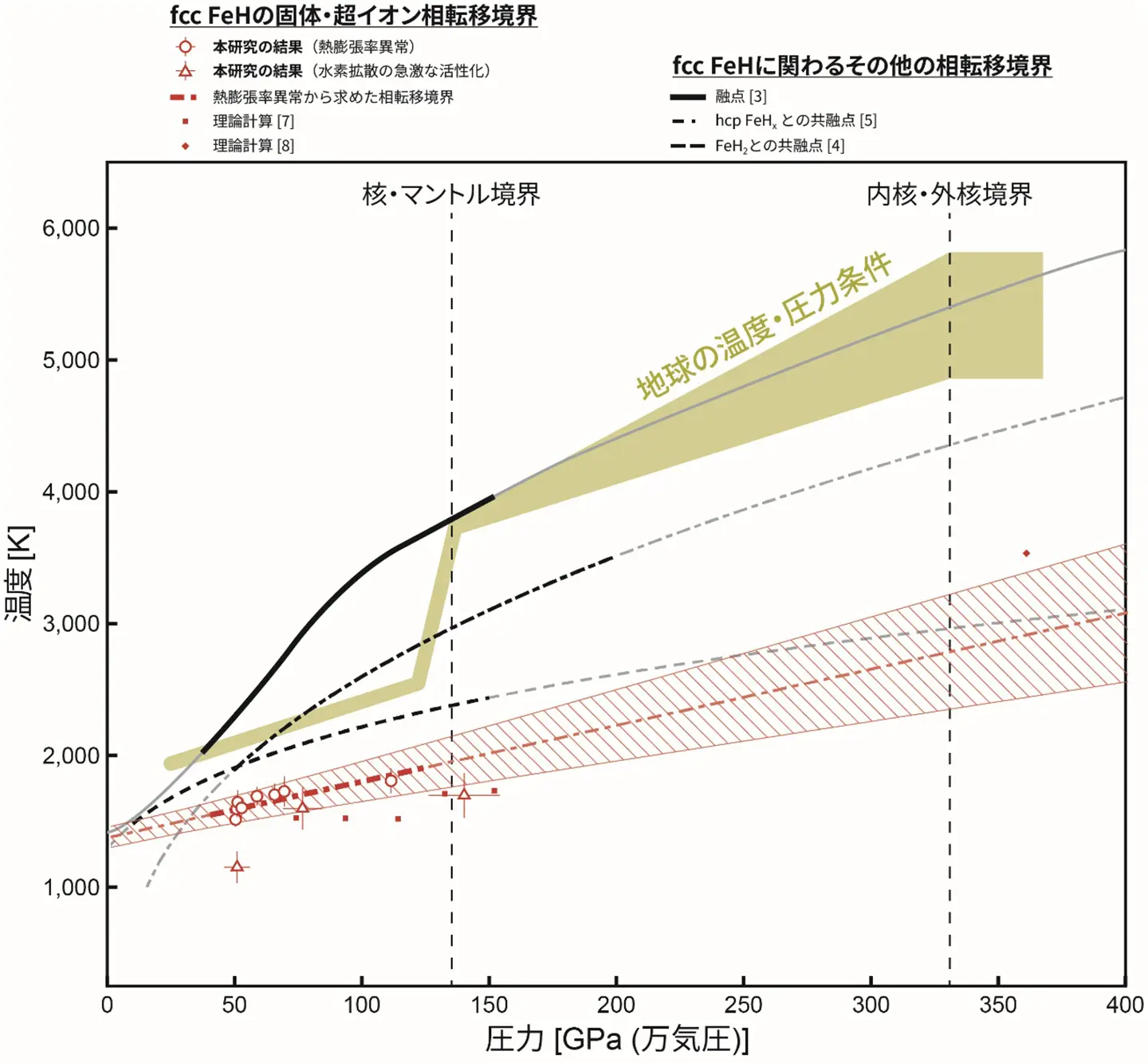
図1. 本研究の結果から得られた面心立方鉄水素合金(fcc FeHx)の相平衡図。
<関連情報>
地球の核条件下における水素化鉄の超イオン挙動の実験的証拠 Experimental indications of superionic behaviour in iron hydride under Earth’s core conditions
Yoshihiro Nagaya,Yusuke Okazaki,Haruhiko Dekura & Kenji Ohta
Nature Geoscience Published:09 June 2026
DOI:https://doi.org/10.1038/s41561-026-02001-5
Abstract
Earth’s inner core is believed to consist of an iron–light-element alloy such as iron hydride (FeHX). The possibility that a superionic state may emerge in the inner core has recently gained attention as a physico-chemical phenomenon for explaining its seismological properties, such as slow shear-wave velocities and seismic anisotropy. Despite theoretical predictions, direct experimental evidence for superionic behaviour in iron–light-element alloys remains scarce. Here we present in situ, time-resolved X-ray diffraction measurements in a laser-heated diamond-anvil cell. Our experimental observations are consistent with superionic behaviour in face-centred cubic iron hydride (X ~ 1) up to 140 gigapascals—corresponding to Earth’s core pressure. We interpret the anomalous thermal expansion of iron hydride that we observe as consistent with behaviour reported for other superionic materials. In addition, our laser-heating experiments on iron hydride under a constant voltage bias reveal an abrupt migration of hydrogen at the superionic transition temperature. These results suggest that hydrogen in the superionic state may carry a negative charge and diffuse more slowly than predicted by ab initio calculations. These findings suggest that if hydrogen indeed has been incorporated into the inner core during its formation, it can be retained over geodynamic timescales.