2026-06-11 農研機構,国際農研,高崎健康福祉大学,吉備国際大学,国際稲研究所(IRRI),東京大学
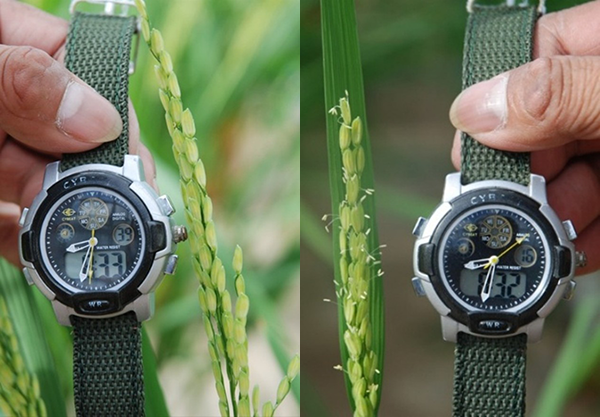
図1 通常のイネ(左)では開花しない午前8時半に開花している早朝開花イネ(右)
<関連情報>
- https://www.naro.go.jp/publicity_report/press/laboratory/carc/176068.html
- https://onlinelibrary.wiley.com/doi/10.1111/pbi.70653
イネのEMF3対立遺伝子は高温ストレス下で開花時期を調整し、種子形成率を高める Rice EMF3 Alleles Adjust Flower Opening Time to Enhance the Seed Setting Rate Under High Temperature Stress
Takuma Ishizaki, Yoichi Hashida, Hideyuki Hirabayashi, Kazuhiro Sasaki, Hiroki Tokunaga, Eliza Vie M. Simon-Ada, Masataka Wakayama, Toshiyuki Takai, Hiroki Saito, …
Plant Biotechnology Journal Published: 09 April 2026
DOI:https://doi.org/10.1111/pbi.70653
ABSTRACT
To safeguard global food security against rapid population growth and a warming world, the effective genetic improvement of cereals is imperative. Flower opening time (FOT) critically affects the seed setting rate. In this study, we identified a gene, EARLY-MORNING FLOWERING 3 (EMF3), in which single-nucleotide substitutions strongly modulate FOT in rice in a semi-dominant manner, resulting in wide variation in FOT from earlier to later FOT than the wild-type. EMF3 knock-out mutants showed significantly reduced FOT synchrony and disrupted anther dehiscence, leading to fertilisation failure. EMF3 encodes a plasma membrane-localised polypeptide of 723 amino acids with an armadillo repeat fold and four transmembrane segments. Furthermore, EMF3 is specifically expressed in the anthers starting from nighttime on the day of flowering, with substantial impacts on the transcriptomes of both anther and lodicule, which suggested an exclusive role of EMF3 in flowering events. Modifying EMF3 alleles of O. sativa enabled the adjustment of FOT among Oryza species and subspecies, potentially facilitating cross-fertilisation by overcoming one of the major challenges of inter-specific hybridisation to exploit heterosis. Introducing the EMF3 alleles with the earlier FOT into popular rice cultivars resulted in flowering at an earlier time of day when the temperature was cooler, efficiently increasing seed setting rate under heat stress. This discovery unveils the novel mechanism of anther control of flower opening time through the EMF3 gene, while also enabling the use of EMF3 alleles in breeding strategies for efficient fertilisation for increasing hybrid rice seed production and mitigating future heat-stress damage at flowering.