2026-06-11 高エネルギー加速器研究機構,理化学研究所
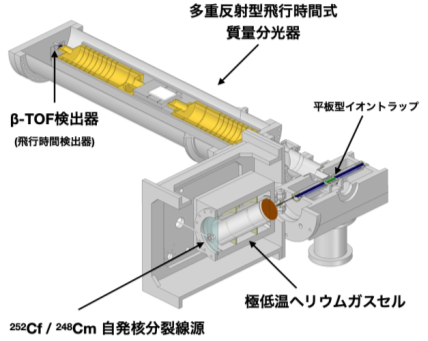
実験装置の概念図
<関連情報>
新しいグラウンドステート149L1ランタン同位体における2つの中性子分離エネルギー異常を除去する New Ground State in 149La Removes Two-Neutron-Separation-Energy Anomaly in Lanthanum Isotopes
S. Kimura, M. Wada, H. Haba, Y. Hirayama, H. Ishiyama, Y. Ito, T. Niwase, M. Rosenbusch, P. Schury et al.
Physical Review Letters Published: 9 June, 2026
DOI: https://doi.org/10.1103/gvxl-vxd4
Abstract
Nuclear mass is a key indicator of how the nuclear shell structure evolves. The recent mass measurement study of neutron-rich lanthanum isotopes [Jaries et al., Phys. Rev. Lett. 134, 042501 (2025)] reveals the presence of a distinct prominence in their two-neutron separation energies. However, its presence has been called into question based on the results of another mass determination [Liu, Ph.D. thesis, University of Notre Dame, 2025, 10.7274/28766600.v1.]. In this Letter, we report an effort to clarify these contradictory results through the use of the simultaneous mass-lifetime measurement of the neutron-rich lanthanum isotope 149La using a multireflection time-of-flight mass spectrograph combined with a β-TOF detector. The peak corresponding to a -decaying state was observed in the time-of-flight spectra at a position of 221(6) keV/c2 lighter than the reported 149La mass in Jaries et al., but our measured result is in excellent agreement with the mass value reported in Liu. We have concluded that this peak is the ground state of 149La. With this, the previously reported distinct prominence in the two-neutron separation energies disappears, while a new kink structure, similar to that in the cerium isotopes, appears. Comparison with theoretical models suggests that a nuclear shape transition from octupole deformation to another type of deformation occurs around N=91 and is likely the cause of this kink structure.