2026-05-11 ミュンヘン大学(LMU)
<関連情報>
- https://www.lmu.de/en/newsroom/news-overview/news/climate-change-how-oxygen-deficiency-changes-metabolic-processes-in-the-ocean-6ed63ba5.html
- https://academic.oup.com/ismej/article/20/1/wrag057/8526244
季節的に無酸素状態となるフィヨルドでは、低酸素状態によって微生物によるタウリンの炭素同化が増加する Hypoxia increases microbial carbon assimilation of taurine in a seasonally anoxic fjord
Ömer K Coskun ,William D Orsi ,Ian P G Marshall ,Katharina A Muschler ,Nico Mitschke ,Timothy G Ferdelman ,Gonzalo V Gomez-Saez
The ISME Journal Published:17 March 2026
DOI:https://doi.org/10.1093/ismejo/wrag057
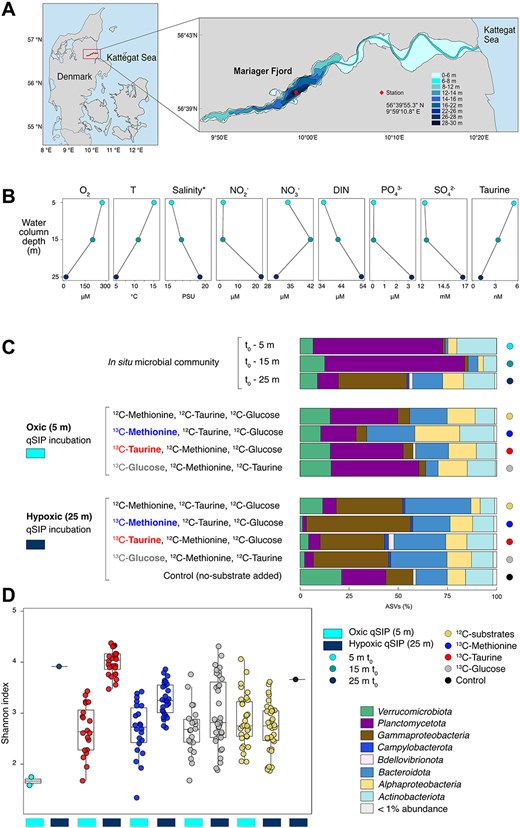
Abstract
Hypoxic zones are expanding globally altering marine biogeochemical cycles. Within these low-oxygen regions, microbial communities play a key role in the production, degradation, and transformation of dissolved organic sulfur (DOS) compounds. Taurine is a bioavailable DOS compound widely utilized by marine microbes with a central role in nutrients exchange, energy production and biomass generation. However, in stratified water columns with varying oxygen conditions, the specific microbial taxa assimilating taurine as a carbon source remain poorly characterized. Here, we applied quantitative stable isotope probing (qSIP) experiments using 13C-labeled organosulfur compounds (taurine and methionine) and 13C-glucose to identify active microbial utilizers in oxic and hypoxic waters in the seasonally anoxic Mariager Fjord (Denmark, Kattegat Sea). Our qSIP results were supported by physicochemical measurements and geochemical data. Taurine-derived 13C-carbon was assimilated into microbial biomass exclusively under hypoxic conditions, primarily by Flavobacteriaceae (Bacteroidota), indicating that taurine serves as a carbon source only when oxygen is limited. 13C-taurine and 13C-methionine assimilation were strongly associated, suggesting a flexible metabolic strategy for utilizing organosulfur compounds in hypoxic waters. In oxic waters, 13C-methionine and 13C-glucose were assimilated by distinct taxonomic groups, dominated by Bacteroidota and Verrucomicrobiota, respectively. Overall, our study identifies active microbial communities assimilating organosulfur compounds under varying oxygen levels in the seasonally anoxic Mariager Fjord, providing new insights into key microbial processes in low-oxygen coastal systems.