2026-05-11 カリフォルニア大学リバーサイド校(UCR)
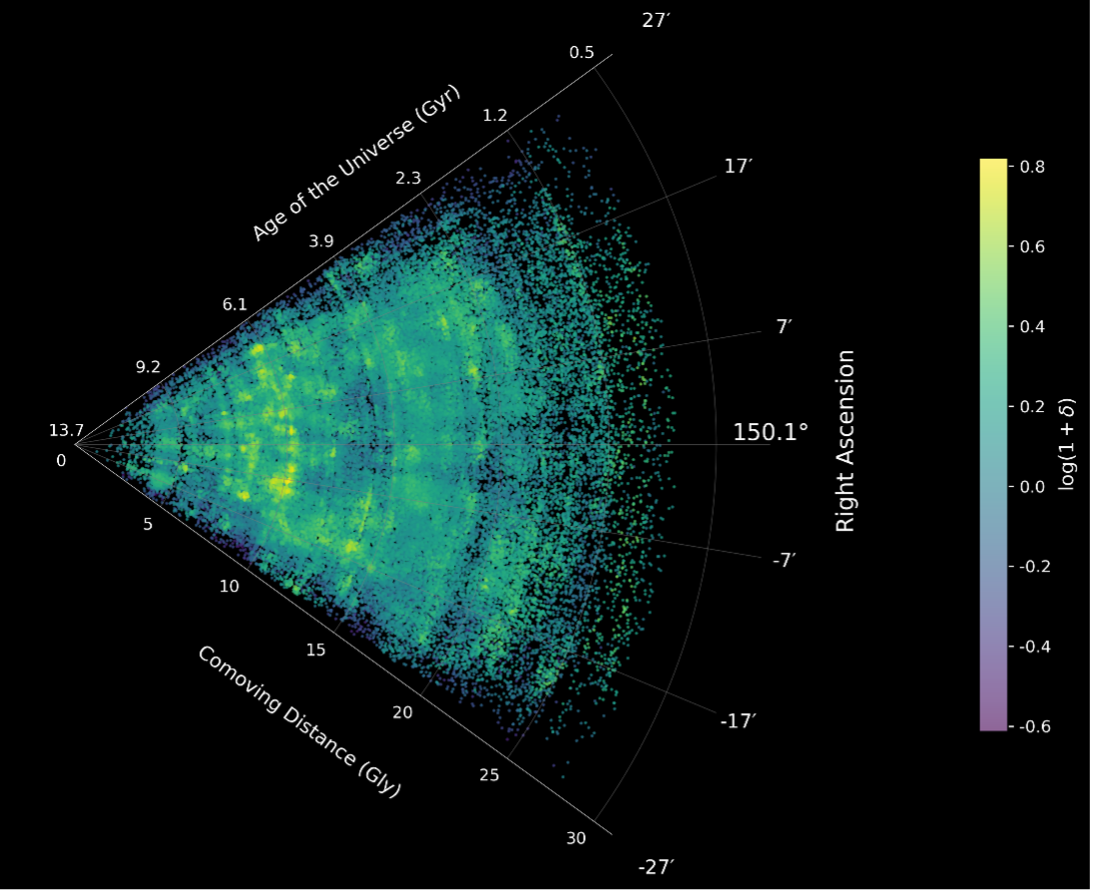
A slice through the COSMOS-Web cosmic-web map, showing galaxies across nearly 14 billion years of cosmic history. The vertex on the left marks the present day; moving outward, each galaxy is placed at its distance in cosmic time, reaching back to when the universe was less than a billion years old. Bright yellow regions show the dense clusters and filaments of the cosmic web, while dark regions mark the near-empty voids in between. (UCR/Hossein Hatamnia)
<関連情報>
- https://news.ucr.edu/articles/2026/05/11/astronomers-produce-most-detailed-map-cosmic-web
- https://iopscience.iop.org/article/10.3847/1538-4357/ae5bac
COSMOS-Webにおける大規模構造: JWST最大規模のサーベイによるz ~7までの宇宙網における銀河進化の追跡 Large-scale Structure in COSMOS-Web: Tracing Galaxy Evolution in the Cosmic Web up to z ∼ 7 with the Largest JWST Survey
Hossein Hatamnia, Bahram Mobasher, Sina Taamoli, Jeyhan S. Kartaltepe, Caitlin M. Casey, Hollis B. Akins, Malte Brinch, Nima Chartab, Nicole E. Drakos, Andreas L. Faisst,…
The Astrophysical Journal Published: 2026 May 6
DOI:10.3847/1538-4357/ae5bac
Abstract
We present a reconstruction of the large-scale structure, using the James Webb Space Telescope (JWST) COSMOS-Web program to trace environmentally driven galaxy evolution up to z ∼ 7. We apply a weighted kernel density estimation method to 164,000 galaxies with robust photometric redshifts. We find that stellar mass has a positive correlation with density at all redshifts, which is stronger for quiescent galaxies (QGs) at z ≲ 2.5, while at higher redshifts (2.5 ≲ z ≲ 5.5) this trend is confined to extreme overdense environments, consistent with early mass assembly in protoclusters. The star formation rate (SFR) shows a negative trend with density for QGs at z ≲ 1.2, reversing at z ≳ 1.8, while star-forming galaxies (SFGs) show a mild positive correlation up to z ∼ 5.5. The specific SFR remains nearly flat for SFGs and declines with density for QGs at z ≲ 1.2. Moreover, mass and environmental quenching efficiencies show that mass-driven processes dominate at z ≳ 2.5, that the two processes act with comparable strength between 0.8 ≲ z ≲ 2.5, and that environmental quenching becomes stronger for low-mass galaxies (M⋆ ≲ 1010M⊙) at z ≲ 0.8. These findings reveal that large-scale structure drives galaxy evolution by enhancing early mass assembly in dense regions and increasingly suppressing star formation in low-mass systems at later times, establishing the environmental role of the cosmic web across cosmic history. COSMOS-Web, the largest JWST survey, provides accurate and deep photometric redshifts, reaching 80% mass completeness at logM⋆/M⊙ ∼ 8.7 at z ∼ 7, enabling the first view of how environments shaped galaxy evolution from the Epoch of Reionization to the present day.