2026-05-07 東北大学
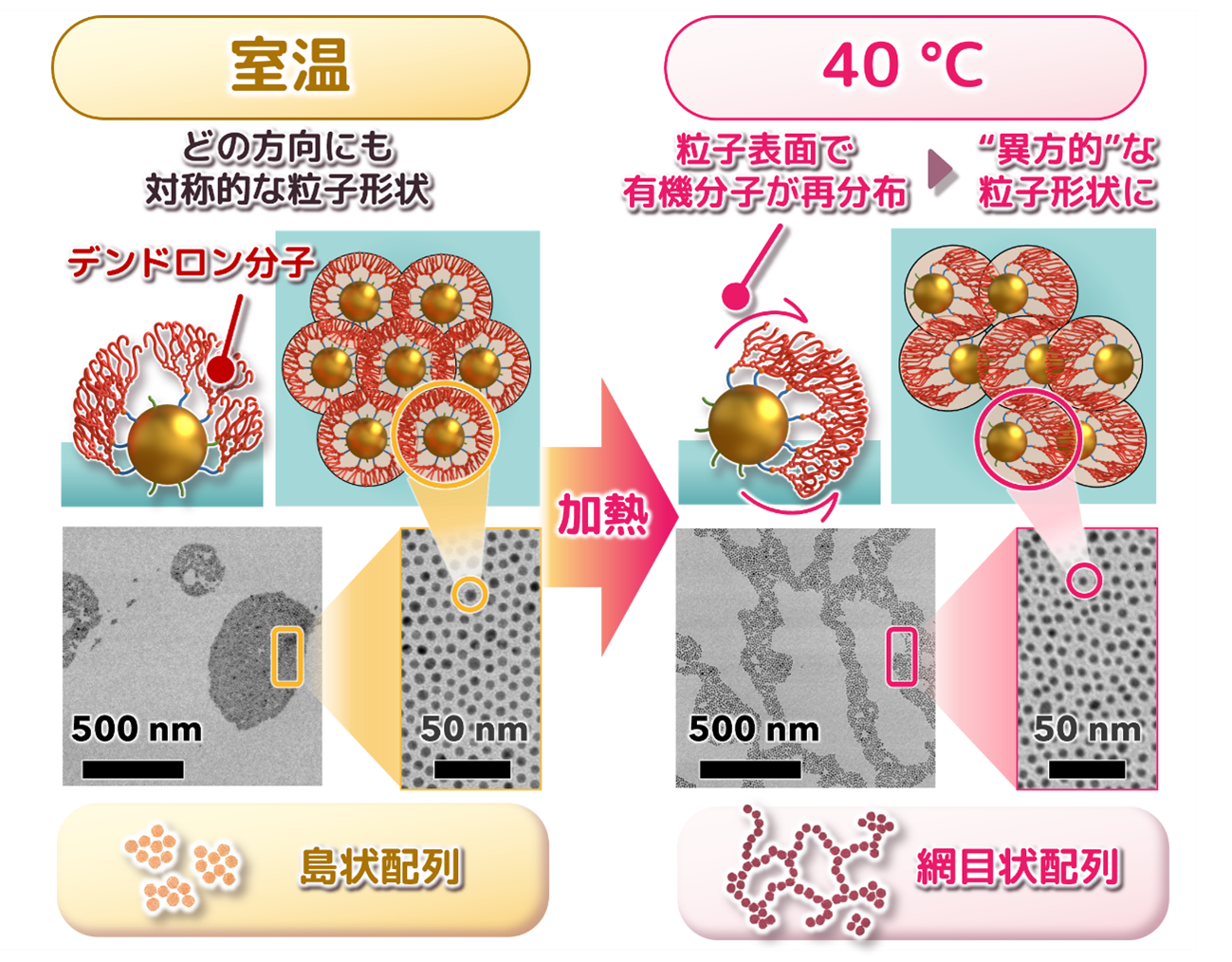
図1. 金ナノ粒子表面での有機分子の再分布による粒子形状異方性の変化と 島状から網目状への粒子配列構造の変化。
<関連情報>
- https://www.tohoku.ac.jp/japanese/2026/05/press20260507-02-nano.html
- https://pubs.acs.org/doi/10.1021/jacs.5c22437
温度および圧力によって誘発される配位子の異方性が、デンドロン化金ナノ粒子単分子膜の構造再編成を促進する Temperature- and Pressure-Induced Ligand Anisotropy Drives Structural Reorganization of Dendronized Gold Nanoparticle Monolayers
Rina Sato,Joshua Reed,Emanuel Schneck,and Kiyoshi Kanie
Journal of the American Chemical Society Published: May 1, 2026
DOI:https://doi.org/10.1021/jacs.5c22437
Abstract
Self-assembly at the air/water interface provides a versatile platform for organizing organic ligand-functionalized inorganic nanoparticles (NPs) into two-dimensional monolayers. However, how ligand behavior under interfacial confinement governs collective structural organization of NP assemblies remains poorly understood. Here, we demonstrate that ligand redistribution on Au NPs induces emergent NP shape anisotropy, which in turn drives directional reorganization of interfacial monolayers. A monolayer of Au NPs dual-functionalized with a liquid-crystalline dendron and dodecanethiol reorganizes from island-like arrays to network-like structures upon heating. X-ray reflectometry and grazing-incidence small-angle X-ray scattering further reveal correlated variations in out-of-plane ligand-shell thickness and in-plane lattice constants. Integrating these X-ray results with local structural insights from electron microscopy clarifies that adaptive redistribution of the two coexisting ligands on the NP surface was the key factor that changes the NP shape anisotropy. This ligand-driven anisotropy directly induced directional anisotropy of the macroscopic monolayer structure. Such dynamic ligand redistribution is enabled by a precisely engineered NP surface, dual-functionalized with liquid-crystalline dendrons and simple alkanethiols. Altogether, this work establishes a strategy for designing thermoresponsive NP monolayers with tunable topology at liquid interfaces and highlights how interfacial confinement fundamentally alters ligand-mediated assembly behavior.