2026-05-27 東京科学大学
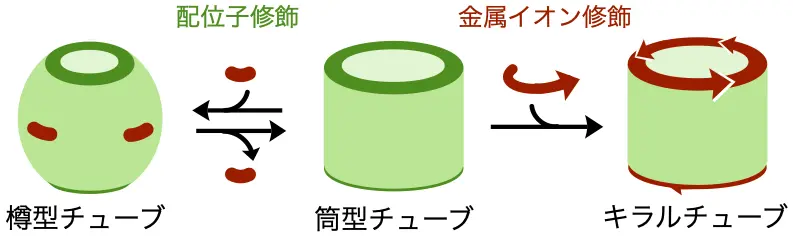
図1. 超分子チューブの作製後修飾:筒型チューブの配位子修飾による樽型チューブ(左)と金属イオン修飾によるキラルチューブ(右)の作製(修飾箇所を赤で示す)
<関連情報>
後アセンブリ配位子/金属修飾による多環芳香族サブナノチューブの空洞収縮とキラル化 Cavity Constriction and Chiralization of Polyaromatic Subnanotubes via Post-assembly Ligand/Metal Modification
Shusuke Yamato,Koki Tagai,Yuya Tanaka,Daiki Tauchi,Masashi Hasegawa,and Michito Yoshizawa
Journal of the American Chemical Society Published: March 26, 2026
DOI:https://doi.org/10.1021/jacs.6c02007
Abstract
Late-stage modification of coordination-driven tubular and cage-like structures is a promising method to tune and alter their cavity functions yet remains difficult owing to the intrinsic instability of metal–ligand bonds against the modification conditions. Here we report polyaromatic tubes with a subnanometer-sized cavity, composed of three metal hinges and three polyaromatic ligands, both of which are modifiable in a post-assembly fashion. The new subnanotube, prepared from PtCl2 salts and the anthracene-embedded bispyridine ligands, is reversibly converted into a constricted subnanotube by the symmetrical modification of the ligands with O2. Using an analogous aqueous tube, one molecule of rod-like coumarin dyes is bound by the subnanocavity in water, and their emission properties are largely enhanced (up to 4-fold) through the ligand modification. On the other hand, the asymmetrical modification of the metal hinges with chiral ammonium groups generates a cryptochiral subnanotube while retaining the polyaromatic cavity. The resultant tube also binds the coumarin dye in water to induce its chiroptical properties as strong CD and CPL activities (up to |gabs| = 2 × 10⁻³ and |glum| = 3 × 10⁻³). Two-directional post-assembly multi-modifications are demonstrated unprecedentedly, using polyaromatic subnanotubes, for the development of multi-functional host–guest systems.