2026-05-04 ペンシルベニア州立大学(Penn State)
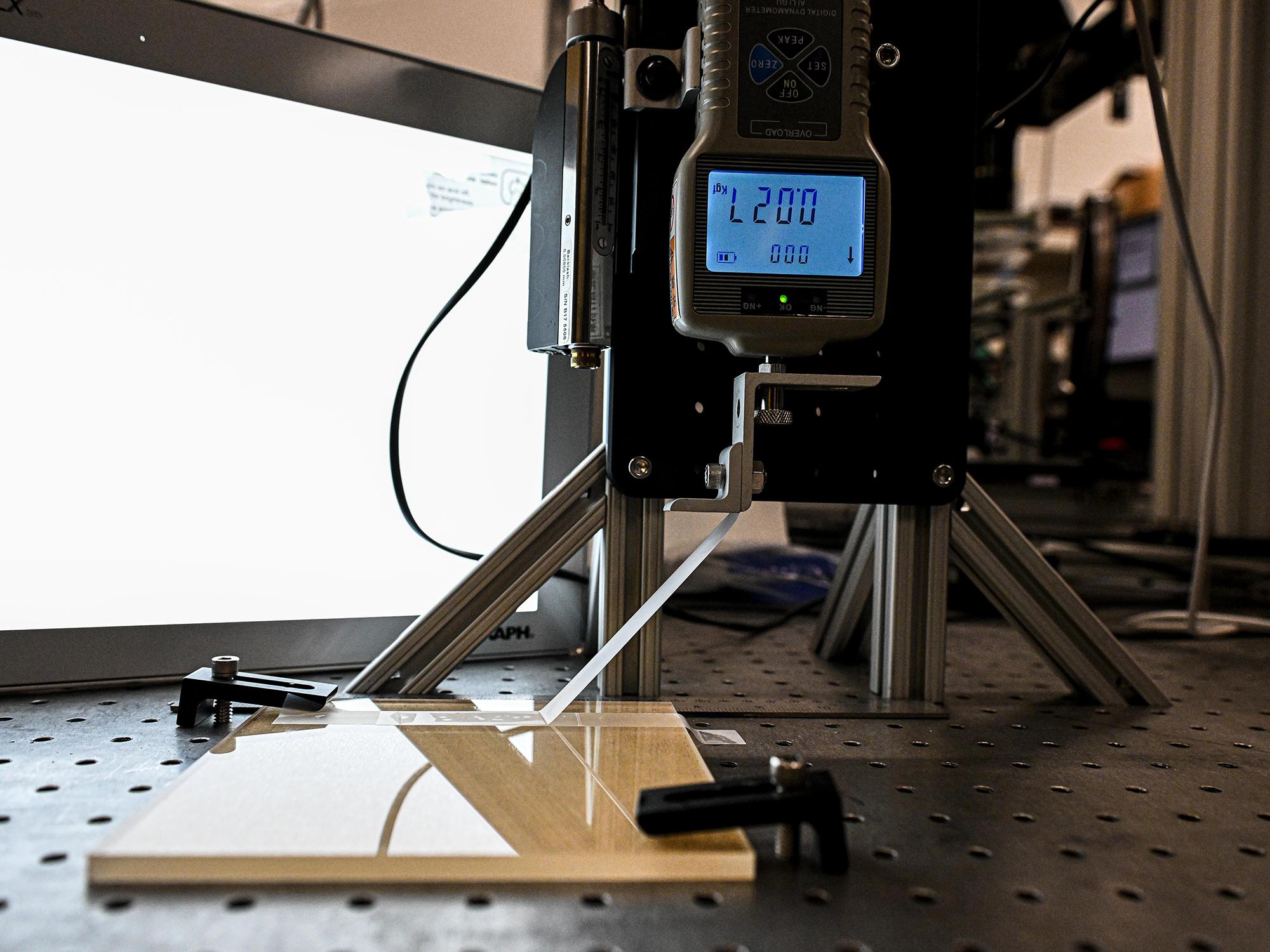
The research team built an automated device that can peel tape to designated distance, lay it back down and measure the amount of force needed to peel the tape. Credit: Jaydyn Isiminger / Penn State. Creative Commons
<関連情報>
- https://www.psu.edu/news/eberly-college-science/story/move-over-cassette-tapes-adhesive-tape-has-memory-too
- https://iopscience.iop.org/article/10.1088/1367-2630/ae4acc
粘着テープの機械的なラッチング記憶 The mechanical latching memory of an adhesive tape
Sebanti Chattopadhyay, Carys Chase-Mayoral and Nathan C Keim
New Journal of Physics Published: 9 March 2026
DOI:10.1088/1367-2630/ae4acc
Abstract
The storage and retrieval of mechanical imprints from past perturbations is a central theme in soft matter physics. Here we study this effect in the partial peeling of an ordinary adhesive tape, which leaves a line of strong adhesion at the stopping point. We show how this behavior can be used to mechanically store and retrieve the amplitudes of successive peeling cycles. This multiple-memory behavior resembles the well-known return-point memory found in many systems with hysteresis, but crucially the driving here is rectified: peeling is unidirectional, where each cycle begins and ends with the tape flat on the substrate. This condition means that the tape demonstrates a distinct principle for multiple memories. By considering another mechanism that was recently proposed, we establish ‘latching’ as a generic principle for memories formed under rectified driving, with multiple physical realizations. We show separately that tape can be tuned to erase memories partially and also demonstrate the function of tape as a mechanical computing device that extracts features from input sequences and compares successive values.