2026-05-26 国立天文台
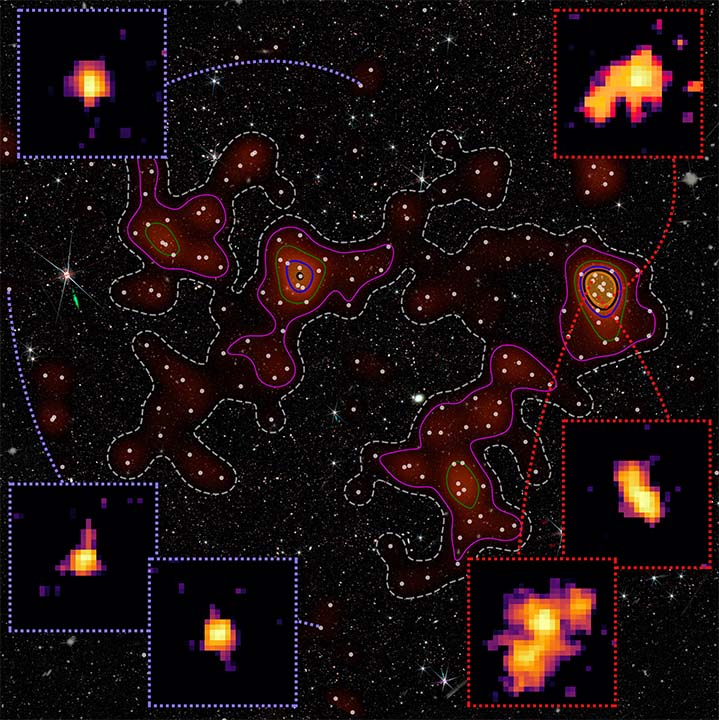
ロクタク原始銀河団領域。ハッブル宇宙望遠鏡(可視光線)とJWST(赤外線)の観測を合わせて作成した疑似カラー画像。白い点はすばる望遠鏡の観測で見つかった銀河。オレンジ色の領域は銀河が密集している場所を、白い破線で囲んだ領域はロクタク原始銀河団全体の広がりを示している。赤枠と青枠の拡大画像はそれぞれ、銀河が密集した環境にある銀河と平均的な環境にある銀河の例。(クレジット:Laishram et al./NAOJ/NASA/ESA/CSA)
<関連情報>
- https://www.nao.ac.jp/news/science/2026/20260526-subaru.html
- https://iopscience.iop.org/article/10.3847/2041-8213/ae5824
z ≃ 4.9 Lyのα線放出原始銀河団の発見:波長依存的な環境が銀河構造に及ぼす影響 Discovery of a z ≃ 4.9 Lyα Emitter Protocluster: Wavelength-dependent Environmental Effects on Galaxy Structure
Ronaldo Laishram, Yusei Koyama, Haruka Kusakabe, Satoshi Kikuta, Shunta Shimizu, and Tadayuki Kodama
The Astrophysical Journal Letters Published: 2026 April 27
DOI:10.3847/2041-8213/ae5824
Abstract
We report the discovery of a Lyα emitter (LAE) protocluster at z = 4.90 in the COSMOS field, comprising four distinct overdensity peaks spanning ∼65 × 36 cMpc2, with the primary concentration exhibiting a fourfold surface density enhancement relative to the field within a 1.5 proper Mpc (pMpc) radius. Using SILVERRUSH narrowband survey data combined with JWST COSMOS-Web imaging, we perform one of the first systematic rest-frame optical and UV morphological comparisons of protocluster versus field LAEs at this redshift using JWST NIRCam rest-frame UV (F150W, ∼2540 Å) and optical (F277W, ∼4700 Å) imaging. Sérsic profile fitting for 16 protocluster members and 23 field LAEs reveals a size difference: protocluster LAEs are ∼40% larger in rest-optical (median Re=0.81+0.26-0.04 kpc versus 0.58+0.11-0.04 kpc, p = 0.041), with no significant difference in rest-UV (p = 0.51) or Sérsic index. At fixed stellar mass, protocluster LAEs are offset by +0.12 dex (≃31%) in rest-optical size from the field size–mass relation (68% confidence interval (CI): [+0.08, +0.21]; Mann–Whitney p = 0.033), with 75% exhibiting positive size residuals compared to 44% of field LAEs. This wavelength-dependent environmental signature suggests that protocluster environments at z ≃ 5 preferentially affect extended stellar populations, possibly through tidal interactions, with no significant environmental difference detected in rest-UV sizes, providing observational evidence for environmental influences on the structure of LAEs during the early buildup phase of cosmic star formation.