2026-05-13 中国科学院新疆生態地理研究所(XIEG)
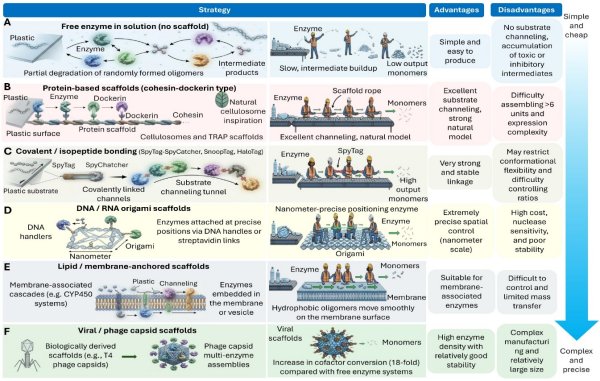
Fig. 1. Main strategies for spatial organization and coordination of multienzyme cascades applied (or potentially applicable) to plastic depolymerization and upcycling. (Image by XIEG)
<関連情報>
- http://english.egi.cas.cn/rp/202605/t20260513_1159255.html
- https://www.sciencedirect.com/science/article/abs/pii/S0734975026001254
酵素によるプラスチックの解重合:実験室での可能性から循環型経済の現実へEnzymatic plastic depolymerization: From lab promise to circular reality
Osama Abdalla Abdelshafy Mohamad, Tamer Elsamahy, Yong-Hong Liu, Xurui Li, Shuai Li, Govindan Rajivgandhi, Yuanming Zhang, Wen-Jun Li
Biotechnology Advances Available online 9 May 2026
DOI:https://doi.org/10.1016/j.biotechadv.2026.108919
Highlights
- Biomimetic cascades offer strategic pathways toward closed-loop plastic recycling.
- Synthetic plastic biodegradation can be improved via hybrid chemo-enzymatic systems.
- AI expands enzyme design but requires validation at complex plastic interfaces.
- Techno-economic analysis confirms recycling potential under optimized conditions.
- A proposed 2030–2040 roadmap guides scalable circular enzymatic recycling.
Abstract
Global plastic production continues to rise, yet most recycling strategies fail to deliver true circularity. Enzymatic plastic depolymerization has been widely promoted as a scalable solution. However, its real-world potential remains poorly defined. This review critically examines why many enzymatic approaches succeed in the laboratory yet break down when applied to heterogeneous post-consumer plastic waste. Evidence across polymers and processes shows that enzymatic depolymerization is fundamentally constrained by polymer chemistry rather than enzyme availability. Plastics with hydrolyzable backbones allow true depolymerization and closed-loop monomer recovery. In contrast, dominant polyolefins largely resist enzymatic attack, with reported effects limited to surface oxidation rather than verified chain scission. Many claimed advances rely on indirect measurements, pristine substrates, or abiotic pretreatments, overstating relevance to real waste streams. While enzyme engineering and artificial intelligence/machine learning (AI/ML)-guided design have significantly enhanced performance on hydrolyzable plastics, these gains frequently entail trade-offs in stability, specificity, and cost, and fail to address key limitations from solid-polymer interfaces and additives. Techno-economic studies indicate that optimized enzymatic recycling of hydrolyzable plastics could reach costs of $1.1–1.8/kg under favorable conditions. However, polyolefins require integrated pretreatment and hybrid chemo-enzymatic strategies for meaningful valorization. The review concludes with a constraint-aware 2030–2040 roadmap, positioning enzymatic recycling as a realistic but inherently limited contributor to a circular plastics economy.