2026-04-29 ウィスコンシン大学マディソン校((UW-Madison))
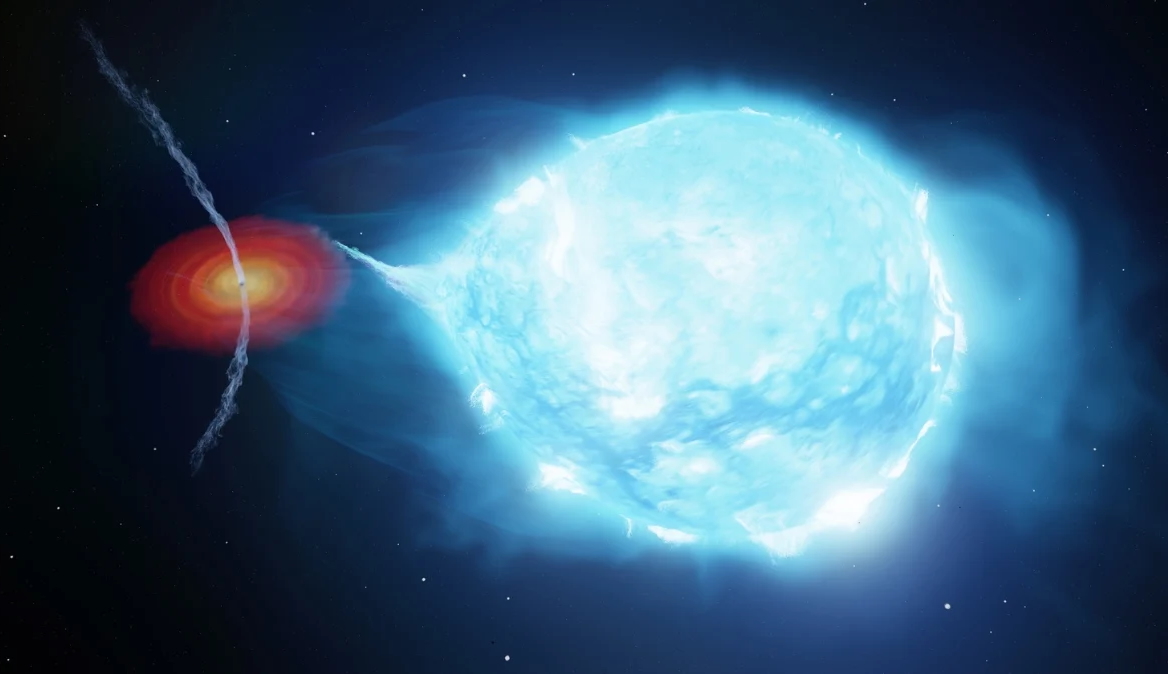
Jets of energetic particles streaming away from the black hole Cygnus X-1 (at left in this artist’s rendering) bend in the stellar wind from the supergiant star paired in orbit with the black hole. Researchers used the extent of the bending to produce the first measurement of the power of a black hole’s jets. Image: ICRAR/Curtin University
<関連情報>
- https://news.wisc.edu/scientists-measure-force-of-powerful-jets-streaming-from-a-black-hole-in-the-cygnus-system/
- https://www.nature.com/articles/s41550-026-02828-3
- https://iopscience.iop.org/article/10.1088/0004-637X/801/1/55
ブラックホールX線連星系「はくちょう座X-1」における恒星風によって曲げられたジェット A jet bent by a stellar wind in the black hole X-ray binary Cygnus X-1
S. Prabu,J. C. A. Miller-Jones,A. Bahramian,V. Bosch-Ramon,S. Heinz,S. J. Tingay,C. M. Wood,A. J. Tetarenko,T. N. O’Doherty & V. Tudose
Nature Astronomy Published:16 April 2026
DOI:https://doi.org/10.1038/s41550-026-02828-3
Abstract
Jets provide an important channel for kinetic feedback from accreting black holes into their environment, without which models of the formation of large-scale structure in the Universe fail to reproduce the observed properties of galaxies. Hence, an accurate measurement of jet power is critical for understanding black hole growth through accretion and also for quantifying the impact of kinetic feedback. However, the absence of instantaneous jet power measurements has precluded direct comparisons with the accretion luminosity, forcing kinetic feedback models to rely on ad hoc assumptions about how much jet power is released per accreted amount of mass. Here using 18 years of high-resolution radio imaging, we report the detection of stellar wind-induced bending of the jets in the black hole X-ray binary Cygnus X-1. By modelling jet–wind interactions, we determine the current kinetic instantaneous power of the jet to be log10[Ljet(ergs-1)]=37.3+0.1-0.2 , comparable with the bolometric X-ray luminosity. This result critically places prevailing assumptions about the energetics of black hole-powered jets in both galaxy formation simulations and in scaling models of black hole accretion on a firm empirical footing.
高質量X線連星におけるマイクロクエーサージェットと恒星風の相互作用に関するグローバルシミュレーショ GLOBAL SIMULATIONS OF THE INTERACTION OF MICROQUASAR JETS WITH A STELLAR WIND IN HIGH-MASS X-RAY BINARIES
D. Yoon and S. Heinz
The Astrophysical Journal Published: 2015 March 4
DOI:10.1088/0004-637X/801/1/55
ABSTRACT
Jets powered by high-mass X-ray binaries must traverse the powerful wind of the companion star. We present the first global three-dimensional simulations of jet–wind interaction in high-mass X-ray binaries. We show that the wind momentum flux intercepted by the jet can lead to significant bending of the jet and that jets propagating through a spherical wind will be bent to an asymptotic angle Ψ∞ . We derive simple expressions for Ψ∞ as a function of jet power and wind thrust. For known wind parameters, measurements of Ψ∞ can be used to constrain the jet power. In the case of Cygnus X-1, the lack of jet precession as a function of orbital phase observed by the Very Long Baseline Array can be used to put a lower limit on the jet power of Ljet≳1036ergs s-1. We further discuss the case where the initial jet is inclined relative to the binary orbital axis. We also analyze the case of Cygnus X-3 and show that jet bending is likely negligible unless the jet is significantly less powerful or much wider than currently thought. Our numerical investigation is limited to isotropic stellar winds. We discuss the possible effects of wind clumping on jet–wind interaction, which are likely significant, but argue that our limits on jet power for Cygnus X-1 are likely unaffected by clumping unless the global wind mass-loss rate is orders of magnitude below the commonly assumed range for Cyg X-1.